
Student Success & Learning Skills
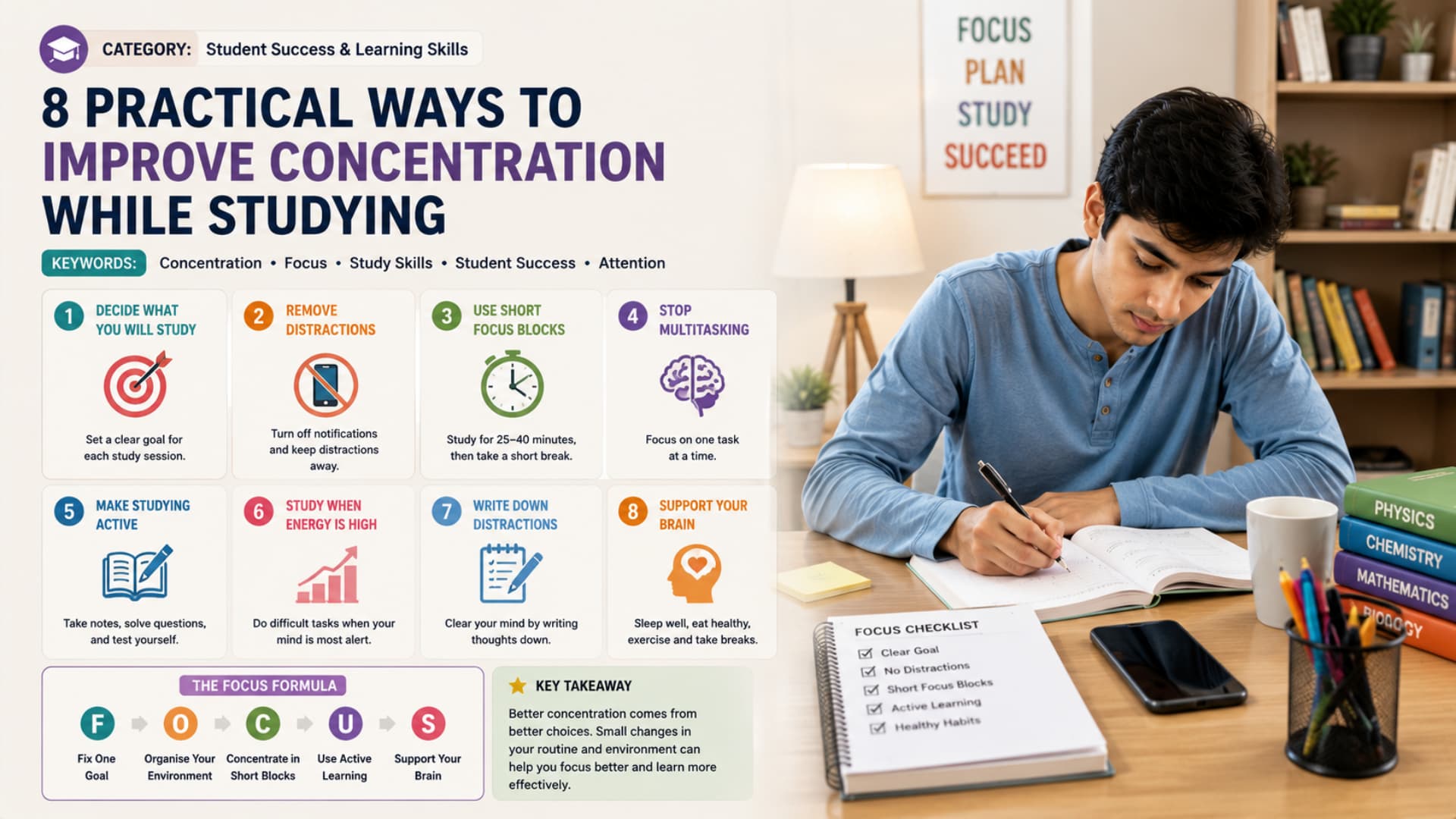
8 Practical Ways to Improve Concentration While Studying
Concentration • Focus • Study Skills • Student Success • Attention
You sit down to study with good intentions.
Then comes a notification.
A random thought.
A conversation.
A quick glance at the phone.
And suddenly, 20 minutes are gone.
Concentration is not about forcing yourself to stare at a book for hours. It is about creating the right conditions for your brain to stay with one task.
Here are 8 practical ways students can improve concentration while studying.
________________________________________
1. Decide Exactly What You Will Study
A vague goal such as:
“I need to study.”
gives the brain very little direction.
Instead, decide:
“I will finish Chapter 3 and solve five questions.”
Why It Helps
A clear target makes it easier to begin and stay focused.
Study Rule
One session = One clear goal.
________________________________________
2. Remove Distractions Before Starting
Do not depend only on willpower.
Make distraction harder.
Before studying:
• Put the phone away
• Turn off notifications
• Close unnecessary tabs
• Keep the desk clear
• Tell family members you are in a focus session
Why It Matters
Every distraction creates a new decision:
“Should I check it?”
Reducing those decisions protects attention.
Control the environment before asking your brain to concentrate.
________________________________________
3. Use Short Focus Blocks
Long sessions often lead to mental fatigue.
Try:
25–40 minutes focused study → 5–10 minute break
Then begin another session.
During the Break
• Walk
• Stretch
• Drink water
• Rest your eyes
Avoid turning every break into social-media scrolling.
Why It Helps
Short focus blocks make concentration feel manageable.
You are not asking:
“Can I focus for three hours?”
You are asking:
“Can I focus well for the next 30 minutes?”
________________________________________
4. Stop Multitasking
Studying while chatting, watching videos or switching between apps may feel productive.
But demanding tasks compete for attention.
Better Approach
Use:
Choose → Focus → Finish → Switch
If you are solving maths, solve maths.
If you are reading, read.
If you are revising, revise.
Study Tip
One task completed well is better than five tasks started badly.
________________________________________
5. Make Studying Active
Passive reading makes the mind wander more easily.
Give your brain something to do.
Try:
• Highlighting key ideas
• Writing short notes
• Solving questions
• Explaining concepts aloud
• Making flashcards
• Drawing diagrams
• Recalling without looking
Why It Helps
Active learning keeps attention engaged.
Instead of just asking:
“Did I read this?”
ask:
“Can I use this information?”
________________________________________
6. Start With the Hardest Task When Energy Is High
Your concentration changes during the day.
Observe when you feel most alert.
Use your best mental period for:
• Difficult subjects
• New concepts
• Problem-solving
• Important revision
Save simpler activities for lower-energy periods.
Why It Matters
Do not waste your strongest concentration on easy tasks.
Study Rule
Match task difficulty with mental energy.
________________________________________
7. Write Down Distracting Thoughts
Sometimes the distraction is not your phone.
It is your own mind.
You suddenly remember:
• Something you need to buy
• A message to send
• Another assignment
• A plan for tomorrow
Keep a small distraction list beside you.
Write the thought down and return to studying.
Why It Helps
You tell your brain:
“I have not forgotten this. I will handle it later.”
That makes it easier to return attention to the task.
________________________________________
8. Support Your Brain With Good Daily Habits
Concentration does not begin when you open the textbook.
It is affected by your overall routine.
Support focus with:
• Adequate sleep
• Physical activity
• Regular meals
• Hydration
• Healthy screen habits
• Meaningful breaks
Why It Matters
A tired or overstimulated brain will naturally struggle to concentrate.
Better focus is supported by better routines.
________________________________________
The FOCUS Formula
F — Fix One Goal
Know exactly what you will complete.
O — Organise Your Environment
Remove distractions.
C — Concentrate in Short Blocks
Protect your attention.
U — Use Active Learning
Keep the brain engaged.
S — Support Your Brain
Sleep, move, hydrate and recover.
________________________________________
Key Takeaway
Better concentration is not created by repeatedly telling yourself:
“Focus harder.”
It improves when you make better choices around:
Goals • Environment • Time • Study Method • Energy • Routine
Start with one change.
Put the phone away.
Choose one clear target.
Complete one focused session.
Then build from there.
Focus is not something you wait for. It is something you practise.
Brain Gurukul Perspective
At Brain Gurukul, we believe concentration is one of the foundations of effective learning.
When students learn to protect attention and use it intentionally, they become better prepared to understand, remember and perform.
Train your attention. Strengthen your learning. Improve your performance.
Read. Learn. Apply. Grow.
________________________________________
Blog Number: 41
Blog Name: 8 Practical Ways to Improve Concentration While Studying
Word Count: ~775 words
Concentration • Focus • Study Skills • Student Success • Attention