Brain Science & Brain Optimization
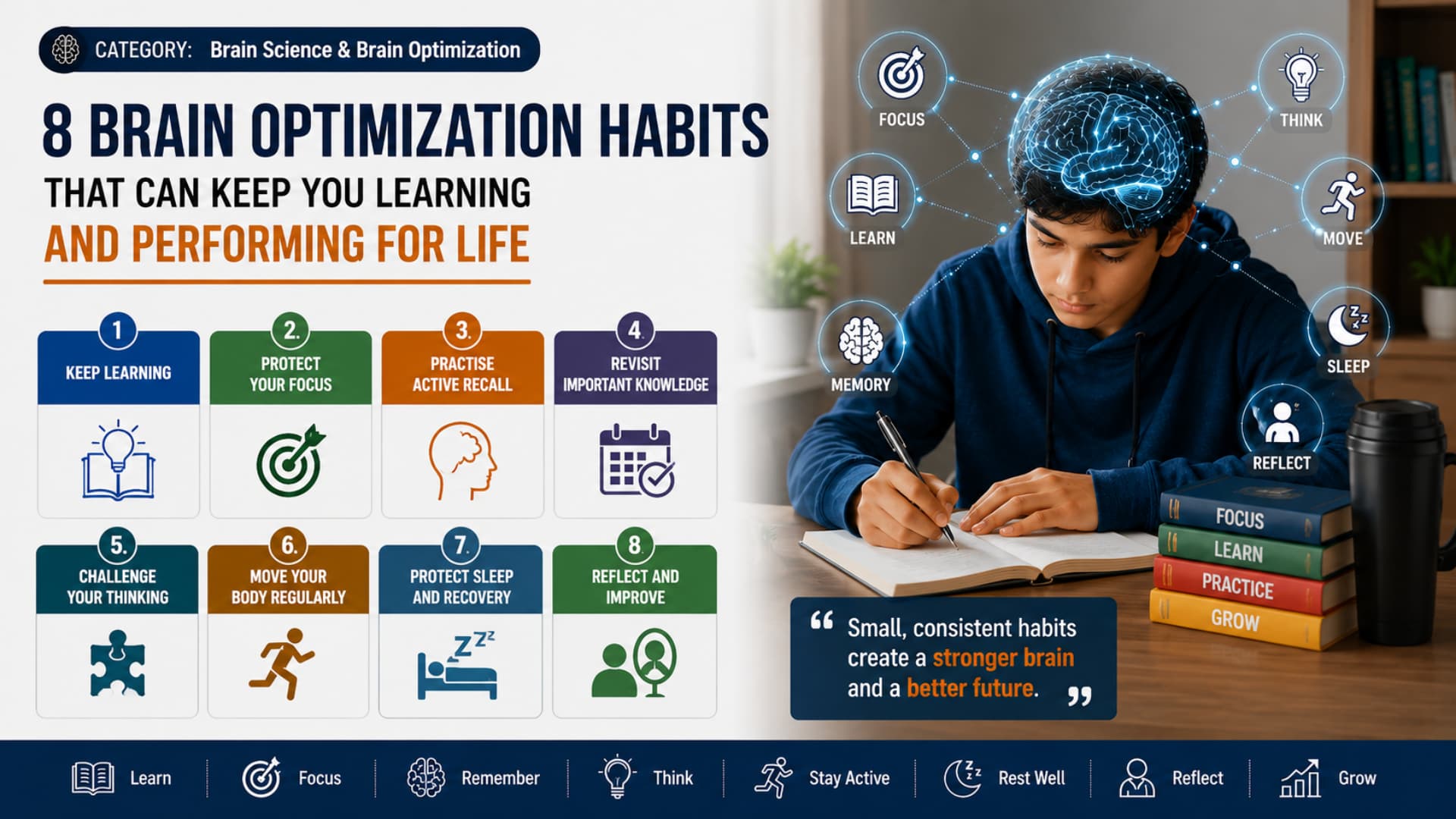
8 Brain Optimization Habits That Can Keep You Learning and Performing for Life
Brain Optimization • Lifelong Learning • Focus • Memory • Mental Performance
What helps some people continue learning, adapting and performing well even as life becomes more demanding?
It is rarely one extraordinary technique.
More often, it is a combination of small, intelligent habits repeated consistently over time.
Brain Optimization is not about pushing the brain harder every day. It is about building routines that support focus, memory, thinking, adaptability and mental well-being.
Here are 8 Brain Optimization habits that can help you keep learning and performing throughout life.
________________________________________
1. Keep Learning Something New
The brain benefits from challenge.
Learning something unfamiliar forces you to pay attention, make connections and develop new strategies.
Try:
• A new language
• Music
• Technology
• Mental maths
• Public speaking
• A professional skill
Why It Matters
Lifelong learning keeps the mind active and adaptable.
Brain Tip:
Do not wait until learning becomes necessary. Make learning a lifestyle.
________________________________________
2. Protect Your Focus
Attention is one of your most valuable mental resources.
Constant notifications, multitasking and task-switching can reduce the quality of learning.
Build Focus Blocks
For 25–40 minutes:
• Choose one task
• Keep the phone away
• Close unnecessary tabs
• Work without switching
• Take a short break afterward
Why It Matters
Better focus helps the brain process information more deeply.
Protect attention before trying to improve performance.
________________________________________
3. Practise Active Recall
Reading information repeatedly does not always guarantee strong memory.
Active recall means trying to remember information without looking at the answer.
Try This
After learning something, ask:
• What were the main points?
• Can I explain them?
• What did I forget?
• Can I apply the idea?
Use:
Learn → Recall → Check → Repeat
This keeps memory active rather than passive.
________________________________________
4. Revisit Important Knowledge
Learning once is often not enough.
Important information becomes easier to retrieve when it is revisited over time.
Use Spaced Review
Try:
Day 1: Learn
Day 2: Recall
Day 4: Review
Day 7: Test yourself
Why It Matters
Regular revision reduces the need to relearn everything from the beginning.
Repeat intelligently, not endlessly.
________________________________________
5. Challenge Your Thinking
Mental performance is not only about remembering facts.
It also depends on how well you can:
• Analyse
• Compare
• Question
• Solve
• Decide
• Adapt
Train It Through
• Logic puzzles
• Strategy games
• Case studies
• Real-world problems
• Critical questions
• Exploring different viewpoints
Brain Tip
Ask more often:
“Why?”
“What if?”
“What else could work?”
Good questions strengthen thinking.
________________________________________
6. Move Your Body Regularly
Brain health and physical health are closely connected.
Regular movement supports energy, alertness and overall well-being.
You can choose:
• Walking
• Cycling
• Sports
• Yoga
• Dancing
• Strength exercises
Why It Matters
A healthy learning routine should not involve sitting all day.
Move the body to support the mind.
________________________________________
7. Protect Sleep and Recovery
Mental performance declines when recovery is ignored.
Poor sleep can affect:
• Focus
• Memory
• Mood
• Decision-making
• Reaction time
Build Better Recovery Habits
• Maintain regular sleep timings
• Reduce late-night screen exposure
• Take meaningful breaks
• Avoid working continuously until exhaustion
Remember
Rest is not the opposite of performance. It supports performance.
________________________________________
8. Reflect and Improve
One of the most powerful Brain Optimization habits is reflection.
At the end of a day, week or project, ask:
• What worked?
• What distracted me?
• What did I learn?
• Where did I struggle?
• What should I change next time?
Why It Matters
Reflection turns experience into improvement.
Without reflection, the same mistakes can be repeated.
With reflection, learning becomes more intentional.
________________________________________
The LIFELONG Formula
L — Learn Continuously
Stay curious.
I — Improve Focus
Protect your attention.
F — Form Strong Memory Habits
Recall and revisit.
E — Exercise Your Thinking
Solve, question and analyse.
L — Look After Your Body
Move regularly.
O — Optimise Recovery
Sleep and recharge.
N — Notice Your Progress
Reflect on performance.
G — Grow Consistently
Improve one step at a time.
________________________________________
Key Takeaway
Brain Optimization is not a one-time activity.
It is a way of living and learning.
Build habits around:
Learning • Focus • Memory • Thinking • Movement • Recovery • Reflection
and you create better conditions for long-term performance.
The goal is not to become perfect.
It is to keep becoming more capable, adaptable and aware.
Brain Gurukul Perspective
At Brain Gurukul, we believe Brain Optimization should prepare learners not only for the next exam or challenge, but for a lifetime of learning.
Keep learning. Keep adapting. Keep growing.
Read. Learn. Apply. Grow.
________________________________________
Blog Number: 20
Blog Name: 8 Brain Optimization Habits That Can Keep You Learning and Performing for Life
Word Count: ~780 words
Brain Optimization • Lifelong Learning • Focus • Memory • Mental Performance