
Parenting & Child Development
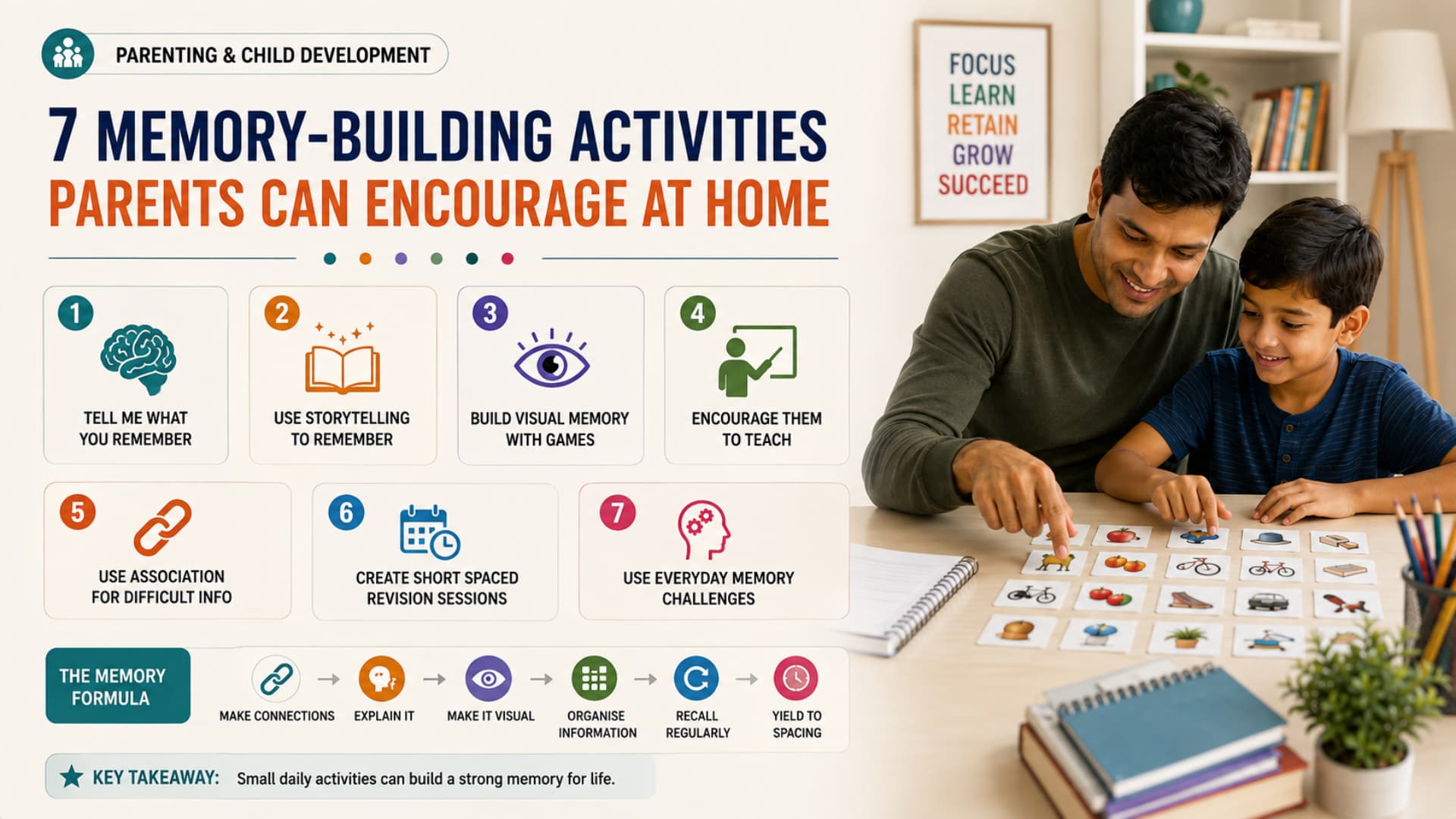
7Memory-Building Activities Parents Can Encourage at Home
Child Memory • Memory Activities • Parenting • Learning Skills • Brain Development
Does your child understand something today but forget it a few days later?
That is normal to some extent.
Memory becomes stronger when children pay attention, connect information, recall it, use it and revisit it over time.
Parents do not need complicated tools to support memory development. Many effective activities can be built into everyday home routines.
Here are 7 simple memory-building activities parents can encourage at home.
________________________________________
1. Play the “Tell Me What You Remember” Game
After your child reads a short passage, watches an educational video or finishes a lesson, ask:
“Tell me the three most important things you remember.”
Do not let them immediately look back at the material.
Why It Helps
This encourages active recall.
The child practises retrieving information instead of simply recognising it again.
Parent Tip
Keep the activity short and relaxed.
Use:
Learn → Close → Recall → Check
This can gradually become a natural revision habit.
________________________________________
2. Use Storytelling to Remember Information
Stories make disconnected information easier to organise.
Suppose a child needs to remember several objects:
Book • Tree • Bicycle • Dog • Clock
Instead of repeating the words, create a funny story connecting all five.
Why It Helps
Stories add:
Meaning • Sequence • Imagination • Connection
These additional cues can make information easier to remember.
Try This
Challenge the child to make the strangest or funniest story possible.
The more memorable the connection, the easier recall may become.
________________________________________
3. Build Visual Memory With Observation Games
Place 8–10 everyday objects on a table.
Give your child 30 seconds to observe them.
Then cover the objects and ask:
“How many can you remember?”
You can increase the challenge by changing:
• Number of objects
• Position
• Colour
• Sequence
Why It Helps
This activity practises:
Observation • Attention • Visual Recall
Parent Tip
Turn it into a family game rather than a test.
Memory improves better through regular enjoyable practice than pressure.
________________________________________
4. Encourage Children to Teach What They Learned
One of the best ways to check understanding is to ask the child to teach the idea to someone else.
Say:
“Pretend I know nothing about this. Teach it to me.”
The child may explain:
• A science concept
• A maths rule
• A historical event
• A vocabulary word
Why It Helps
Teaching requires the learner to organise information and retrieve it in their own words.
If they cannot explain one part clearly, that often reveals what needs more revision.
If you can explain it simply, you probably understand it better.
________________________________________
5. Use Association for Difficult Information
New information becomes easier to remember when connected with something familiar.
For example:
A difficult name can be connected to a familiar word.
A science concept can be linked with an everyday object.
A number sequence can be grouped into meaningful chunks.
Parent Question
Ask:
“What does this remind you of?”
Why It Helps
Association gives the brain additional paths to reach the information later.
Connect new knowledge with old knowledge.
________________________________________
6. Create Short Spaced Revision Sessions
Many children revise only before tests.
A better habit is to revisit information over several days.
Try:
Day 1: Learn
Day 2: Recall for 5 minutes
Day 4: Review again
Day 7: Quick self-test
Why It Helps
Repeated retrieval across time strengthens access to important information.
Parent Tip
Revision does not need to be long.
Even short, focused recall sessions can be useful.
Little and often can beat long and occasional.
________________________________________
7. Use Everyday Memory Challenges
Memory practice can happen outside textbooks.
Try asking your child to remember:
• Three grocery items
• Directions to a nearby place
• Names of people met at an event
• A short sequence of instructions
• Details from a family outing
• Steps of a recipe
Why It Helps
This shows children that memory is a life skill, not only an exam skill.
Make It Fun
Say:
“Let’s see how much we can remember without writing it down.”
Then check together.
________________________________________
The MEMORY Formula
M — Make Connections
Link new information with something familiar.
E — Explain It
Teach what you learned.
M — Make It Visual
Use observation and imagination.
O — Organise Information
Use stories and patterns.
R — Recall Regularly
Retrieve without looking.
Y — Yield to Spacing
Revisit information over time.
________________________________________
Key Takeaway
Better memory does not come from repeating information endlessly.
It grows when children actively:
Observe • Connect • Recall • Explain • Review • Apply
Parents can support memory development through simple games and short learning routines without turning home into a high-pressure classroom.
The goal is not:
“Remember everything instantly.”
The better goal is:
“Learn how to remember more effectively.”
Brain Gurukul Perspective
At Brain Gurukul, we believe memory is an important learning ability that can be supported through meaningful techniques, active recall and consistent practice.
Make memory active, meaningful and enjoyable—and learning becomes easier to retain.
Read. Learn. Apply. Grow.
________________________________________
Blog Number: 36
Blog Name: 7 Memory-Building Activities Parents Can Encourage at Home
Word Count: ~775 words
Child Memory • Memory Activities • Parenting • Learning Skills • Brain Development