Parenting & Child Development
7 Reasons Every Child Learns Differently — And Why Parents Should Understand Them
Child Learning • Parenting • Learning Differences • Child Development • Learning Skills
Why can two children sit in the same classroom, listen to the same teacher, study the same chapter—and still understand and perform very differently?
Because every child learns differently.
Children differ in attention, memory, confidence, pace, interests, prior knowledge and the way they respond to challenges.
Understanding these differences can help parents move away from unnecessary comparison and toward more effective support.
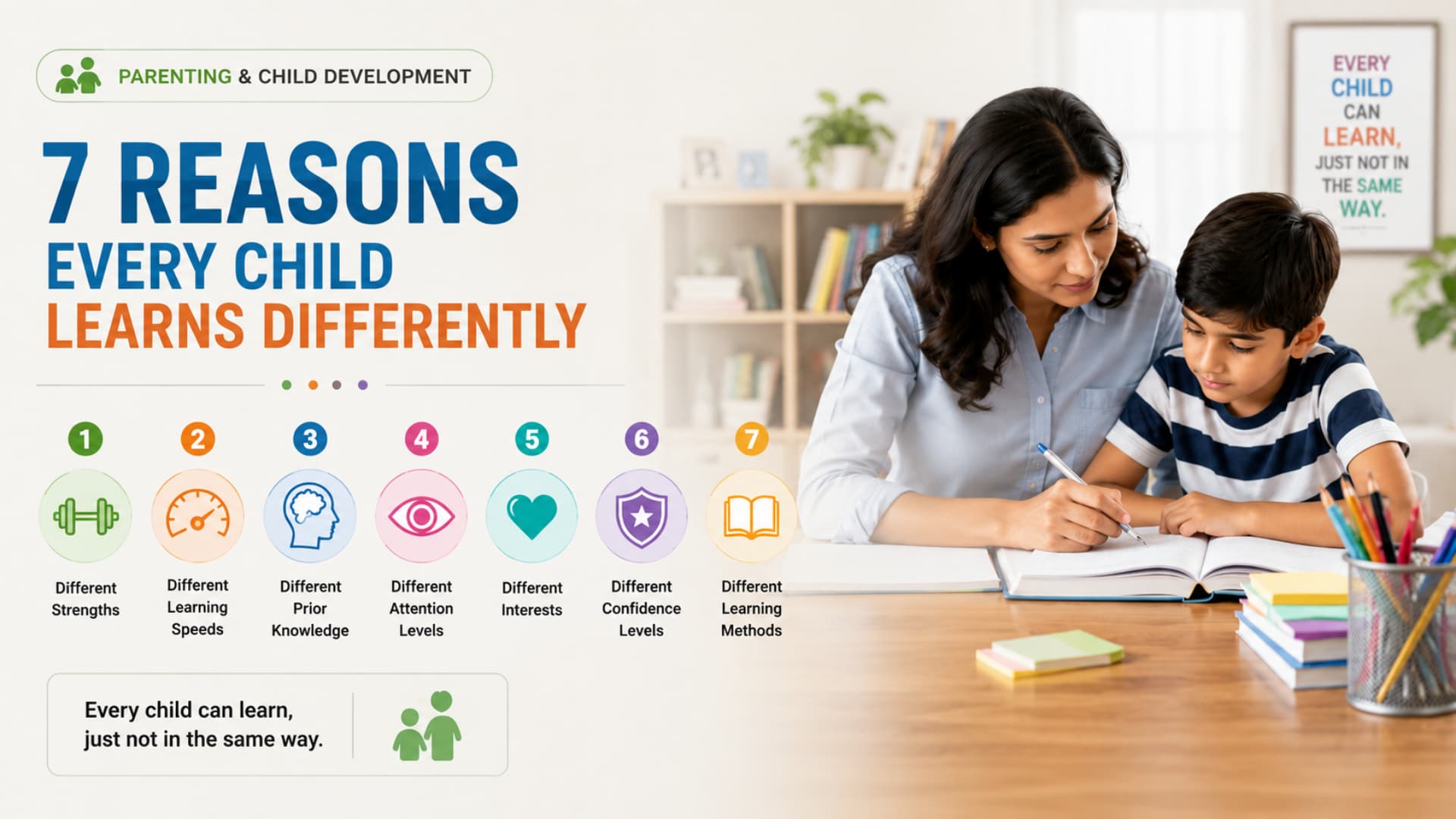
Here are 7 important reasons every child learns differently—and why parents should understand them.
________________________________________
1. Every Child Has Different Strengths
One child may be strong in language.
Another may understand numbers quickly.
Another may excel in art, observation, communication or practical activities.
Why It Matters
When parents expect every child to perform equally in every area, learning can become stressful.
A better approach is to identify:
• Natural strengths
• Areas of interest
• Skills needing support
• Areas requiring more practice
Parent Tip:
Do not judge the whole child through one subject or one report card.
________________________________________
2. Children Learn at Different Speeds
Some children understand a concept immediately.
Others need:
• More examples
• Repetition
• Practice
• Extra explanation
• More time
That does not automatically mean the slower learner is less capable.
Why It Matters
Learning speed and learning ability are not always the same thing.
A child who takes longer initially may eventually understand the concept deeply.
Remember
Different pace does not mean lower potential.
________________________________________
3. Prior Knowledge Changes New Learning
Children do not enter a lesson with identical experience.
A child who already understands the basics of a topic may learn the next level quickly.
Another child may first need to strengthen the foundation.
Example
If multiplication is weak, division may feel much harder.
The problem may not be division itself.
It may be a missing earlier skill.
Parent Tip
When a child struggles, ask:
“Is there a foundation we need to strengthen first?”
________________________________________
4. Attention Levels Differ
Children vary in how long they can stay focused.
Attention can also change depending on:
• Interest
• Sleep
• Environment
• Distractions
• Stress
• Task difficulty
Why It Matters
A child who understands well during short focused sessions may struggle during long study periods.
Instead of simply saying:
“Concentrate more,”
help create better conditions for focus.
Try:
Short study blocks + clear goals + fewer distractions + meaningful breaks
________________________________________
5. Interest Influences Engagement
Children usually engage more deeply when something feels interesting or meaningful.
A child fascinated by space may happily read for an hour about planets but struggle with an unrelated chapter.
Why It Matters
Interest can become a powerful bridge to learning.
Parents can connect difficult topics with:
• Stories
• Real-life examples
• Games
• Projects
• Hobbies
• Questions
Learning Tip
Use interest to open the door—then build the skill.
________________________________________
6. Confidence Affects Performance
A child may know the answer but hesitate because of fear of being wrong.
Repeated criticism, comparison or failure can make learners avoid difficult tasks.
Why It Matters
Confidence influences whether a child is willing to:
• Ask questions
• Attempt difficult work
• Make mistakes
• Participate
• Try again
Parents should praise effort, strategy and improvement, not only final scores.
Instead of:
“Why can't you do this?”
try:
“Let's find another way to understand it.”
________________________________________
7. Children Respond Differently to Teaching Methods
No single method works perfectly for every learner or every topic.
Sometimes a child may understand better through:
• Explanation
• Demonstration
• Practice
• Visual examples
• Discussion
• Hands-on activity
Why It Matters
The goal is not to permanently label a child as one “type” of learner.
The better goal is to use multiple ways of explaining and practising until understanding develops.
Parent Rule
Adapt the method—not the expectations of growth.
________________________________________
The CHILD Formula
C — Celebrate Strengths
Notice what the child does well.
H — Honour the Pace
Give enough time to understand.
I — Identify Gaps
Strengthen missing foundations.
L — Link Learning With Interest
Make information meaningful.
D — Develop Confidence
Encourage effort, practice and improvement.
________________________________________
Key Takeaway
Every child is different.
That difference should not become a reason for comparison.
It should become a reason for better understanding.
Parents who understand how their child learns can provide more useful support, reduce unnecessary pressure and help build stronger confidence.
The goal is not to make every child learn the same way.
It is to help every child learn better.
Brain Gurukul Perspective
At Brain Gurukul, we believe effective learning begins with understanding the learner.
Children should be supported according to their strengths, needs, pace and developmental journey.
Understand the child first—and learning becomes easier to guide.
Read. Learn. Apply. Grow.
________________________________________
Blog Number: 21
Blog Name: 7 Reasons Every Child Learns Differently — And Why Parents Should Understand Them
Word Count: ~780 words
Child Learning • Parenting • Learning Differences • Child Development • Learning Skills