Student Success & Learning Skills
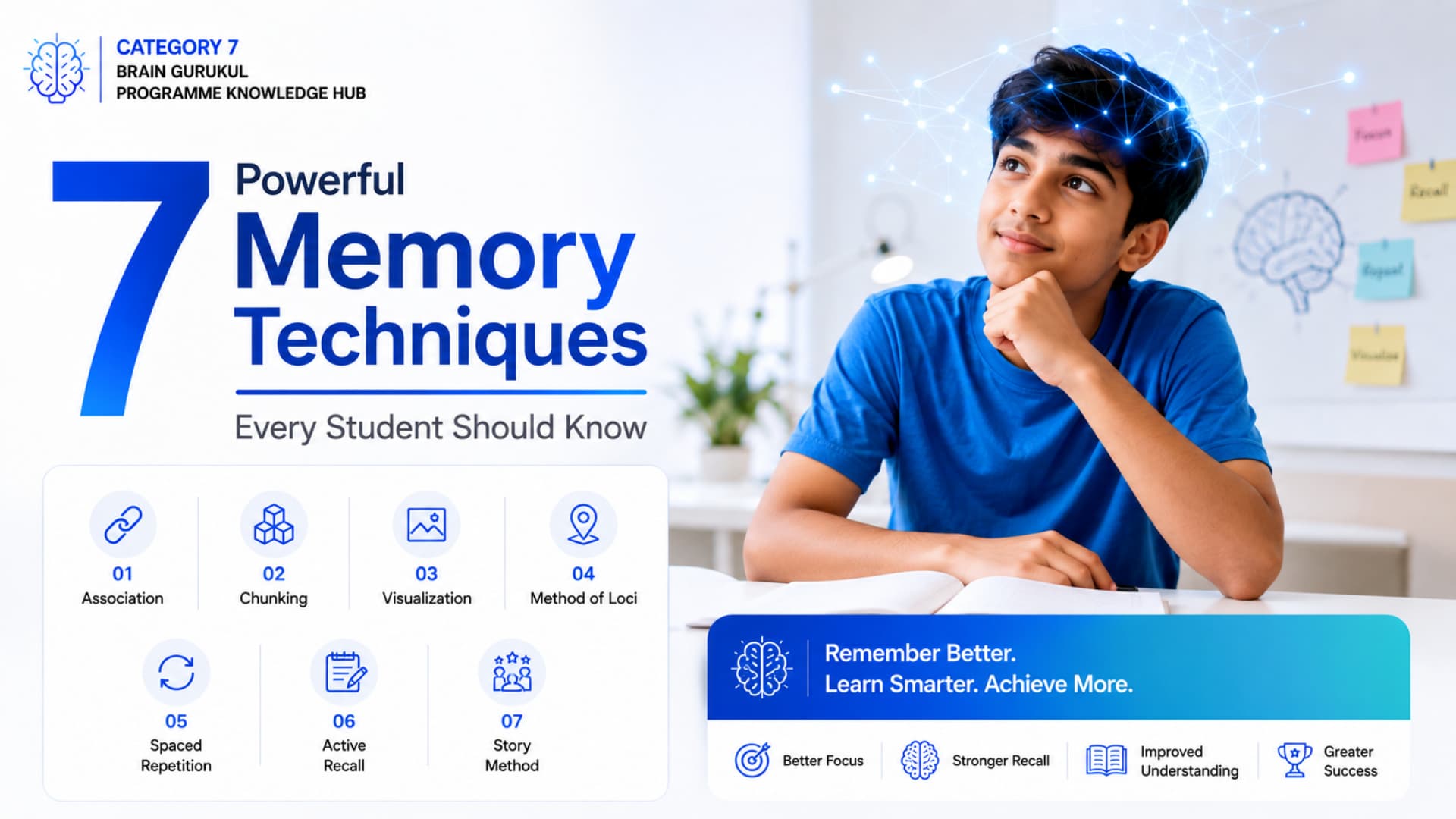
7 Powerful Memory Techniques Every Student Should Know
Memory Techniques • Student Memory • Study Skills • Mnemonics • Active Recall
Have you ever studied a chapter, understood it well, and then struggled to remember it during an exam?
That is one of the most common student problems.
The solution is not always to read the same page again and again.
Memory becomes stronger when information is connected, organised, recalled and revisited.
Here are 7 powerful memory techniques every student should know.
________________________________________
1. Use Active Recall
Active recall means trying to remember information without looking at the answer.
After reading a topic:
Close the book and ask yourself:
• What were the main points?
• Can I explain the concept?
• What did I forget?
• Can I answer a question on it?
Why It Works
Your brain practises retrieving the information instead of only recognising it.
Use:
Read → Close → Recall → Check
This is one of the simplest ways to make studying more active.
________________________________________
2. Use Spaced Revision
Trying to learn everything in one sitting can make revision exhausting.
Instead, revisit the topic over time.
For example:
Day 1: Learn
Day 2: Recall
Day 4: Review
Day 7: Test yourself
Why It Helps
Each revisit strengthens access to the information.
Study Tip
Do not wait until the exam to discover what you have forgotten.
Review before forgetting becomes complete.
________________________________________
3. Create Strong Associations
The brain remembers new information better when it is connected with something familiar.
Suppose you need to remember a difficult word.
Connect it with:
• An image
• A known word
• A person
• A place
• A funny idea
• A real-life example
Why It Works
Association gives the brain more than one pathway to reach the memory.
Memory Rule
The stronger the connection, the easier the recall.
________________________________________
4. Use Mnemonics
Mnemonics are memory tools that make information easier to remember.
They may use:
• Acronyms
• Rhymes
• Stories
• First-letter methods
• Visual associations
For example, instead of trying to remember several unrelated points individually, create a meaningful word or phrase using their first letters.
Why It Helps
Mnemonics organise information into a form that is easier for the brain to retrieve.
Study Tip
The mnemonic does not need to sound serious.
Sometimes the funniest one is the easiest to remember.
________________________________________
5. Visualise What You Learn
Images are often easier to remember than abstract words.
Try turning information into a mental picture.
If you are learning about the heart, imagine blood moving through different chambers.
If you are studying geography, create a mental journey through locations.
Why It Works
Visualisation adds another layer of meaning to the information.
Try This
Ask:
“If this concept became a picture, what would it look like?”
That simple question can make difficult information more memorable.
________________________________________
6. Teach the Topic to Someone Else
One of the best ways to test memory is to explain the topic without looking at your notes.
Teach:
• A friend
• A sibling
• A parent
• An imaginary student
Why It Helps
Teaching forces you to organise the information and retrieve it in your own words.
If you struggle to explain one part, you have found an area that needs revision.
Memory Test
If you can explain it simply, you probably understand it better.
________________________________________
7. Break Information Into Chunks
The brain finds large amounts of information easier to handle when they are divided into smaller groups.
This is called chunking.
Instead of trying to remember ten unrelated items, group them into smaller meaningful sets.
Example
A long chapter can be divided into:
Concept → Example → Formula → Application → Revision
Why It Helps
Chunking reduces mental overload and creates structure.
Study Rule
Organise first. Memorise second.
________________________________________
The REMEMBER Formula
R — Recall Actively
Test yourself.
E — Expand Connections
Use associations.
M — Make Mnemonics
Create memory shortcuts.
E — Engage Visualisation
Turn ideas into images.
M — Manage With Chunks
Break information into groups.
B — Bring It Back Over Time
Use spaced revision.
E — Explain It
Teach what you know.
R — Repeat Intelligently
Review what still needs work.
________________________________________
Key Takeaway
Strong memory is not about reading the same thing repeatedly.
It is about using better strategies.
Focus on:
Recall • Spacing • Association • Mnemonics • Visualisation • Teaching • Chunking
Instead of asking:
“How many times should I read this?”
ask:
“How many ways can I make my brain retrieve and connect this information?”
That is where smarter memory begins.
Brain Gurukul Perspective
At Brain Gurukul, we believe memory is a skill that becomes stronger when learners use meaningful techniques and active practice.
Remember smarter. Recall faster. Learn with confidence.
Read. Learn. Apply. Grow.
________________________________________
Blog Number: 40
Blog Name: 7 Powerful Memory Techniques Every Student Should Know
Word Count: ~785 words
Memory Techniques • Student Memory • Study Skills • Mnemonics • Active Recall