Brain Science & Brain Optimization
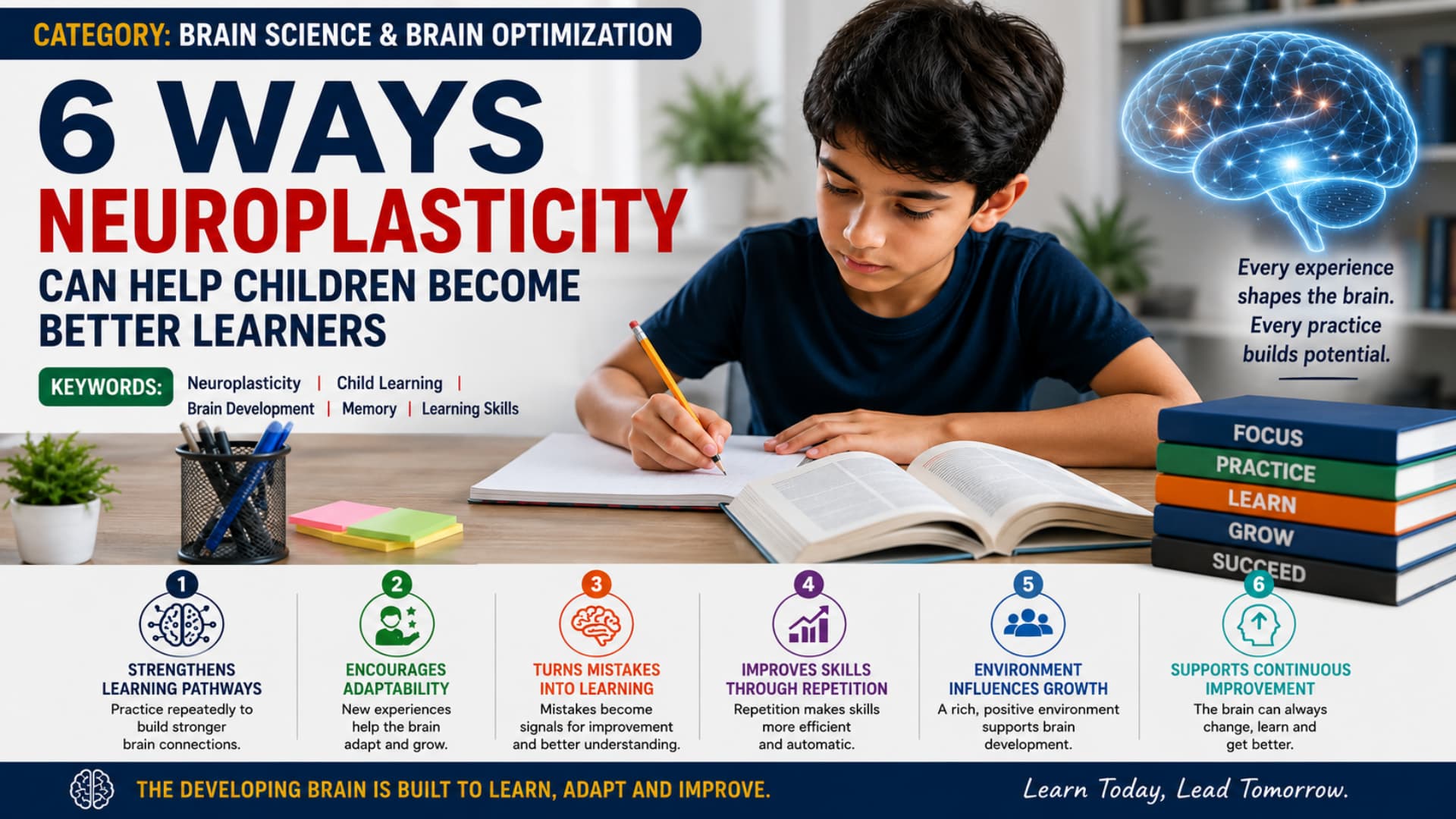
6 Ways Neuroplasticity Can Help Children Become Better Learners
Neuroplasticity • Child Learning • Brain Development • Memory • Learning Skills
Why do children often pick up new words, movements, habits and skills so quickly?
One important reason is neuroplasticity—the brain’s ability to change and reorganise in response to learning and experience.
During childhood and adolescence, the brain is especially responsive to experience. Research shows that training and learning can be associated with changes in brain activity, connectivity and structure in young people.
In simple words:
The developing brain is built to learn, adapt and improve.
Here are 6 ways neuroplasticity can help children become better learners.
________________________________________
1. Practice Can Strengthen Learning Pathways
When children practise something repeatedly, the brain becomes more familiar with that activity.
Whether it is:
• Reading
• Mental maths
• Handwriting
• Music
• Sport
• Memory practice
repeated experience helps the brain refine the networks involved in the skill.
Learning Tip
Encourage:
Learn → Practise → Correct → Repeat
One perfect attempt matters less than consistent meaningful practice.
________________________________________
2. New Experiences Encourage Adaptability
Children's brains are constantly responding to new experiences.
Learning a different subject, solving an unfamiliar puzzle, trying a new sport or exploring a creative activity challenges the brain to adapt.
Why It Matters
Children who regularly experience appropriate new challenges learn that difficulty does not always mean failure.
It can mean:
“My brain is learning something new.”
This mindset can encourage curiosity and persistence.
________________________________________
3. Mistakes Can Become Learning Signals
A mistake tells the learner that the current approach needs adjustment.
That is useful information.
Instead of simply saying:
“Wrong.”
try asking:
• Where did the mistake happen?
• Why did it happen?
• What could we try differently?
• Can you solve a similar problem again?
Use the Learning Loop
Attempt → Feedback → Correction → Retry
When mistakes lead to feedback and another attempt, they can become part of the learning process.
________________________________________
4. Repetition Helps Skills Become More Efficient
At first, a new skill may require intense concentration.
Think of a child learning multiplication tables, keyboard typing or a new handwriting pattern.
With regular practice, the task often becomes easier and faster.
This reflects the brain becoming increasingly efficient at managing familiar skills.
Parent & Teacher Tip
Use short, regular practice sessions instead of occasional exhausting sessions.
For example:
15 minutes daily can often create a better learning routine than one long session once a week.
________________________________________
5. The Environment Can Influence Development
Neuroplasticity does not happen in isolation.
Children learn from their surroundings, relationships, school environment and everyday experiences. Developmental research shows that experience and environment interact with the developing brain throughout childhood and adolescence.
Create a Learning-Friendly Environment
Encourage:
• Conversation
• Reading
• Exploration
• Questions
• Physical activity
• Creative play
• Healthy routines
• Positive feedback
The aim is not to overload children with activities.
It is to provide rich and meaningful experiences.
________________________________________
6. Neuroplasticity Supports Continuous Improvement
Perhaps the most powerful lesson neuroplasticity teaches children is this:
Ability can develop.
A child who struggles today may perform better after the right practice, strategy and support.
That does not mean every child will develop every skill at the same pace.
Children differ in abilities, development and learning needs.
But it does mean we should be careful with limiting labels such as:
“You are bad at maths.”
“You have a poor memory.”
“You are not creative.”
A better message is:
“You are still developing this skill.”
________________________________________
The GROW Learning Formula
G — Give New Experiences
Create opportunities to explore.
R — Repeat Meaningfully
Practise important skills regularly.
O — Observe Mistakes
Use feedback to improve.
W — Work Consistently
Allow development to happen over time.
________________________________________
Key Takeaway
Neuroplasticity does not mean every “brain training” product will automatically make a child smarter; evidence for broad transfer from commercial brain-training programmes is limited.
What it does tell us is more valuable:
Experience matters.
Practice matters.
Environment matters.
Feedback matters.
Consistency matters.
When children receive appropriate challenges and opportunities to practise, their developing brains can continue adapting and learning.
Brain Gurukul Perspective
At Brain Gurukul, we believe children should not be defined only by their current performance.
The objective of Brain Optimization is to help learners discover their potential, develop important abilities and build stronger learning habits over time.
Don't label the learner. Develop the learner.
Read. Learn. Apply. Grow.
(WC = 713)
Neuroplasticity • Child Learning • Brain Development • Memory • Learning Skills