
Student Success & Learning Skills
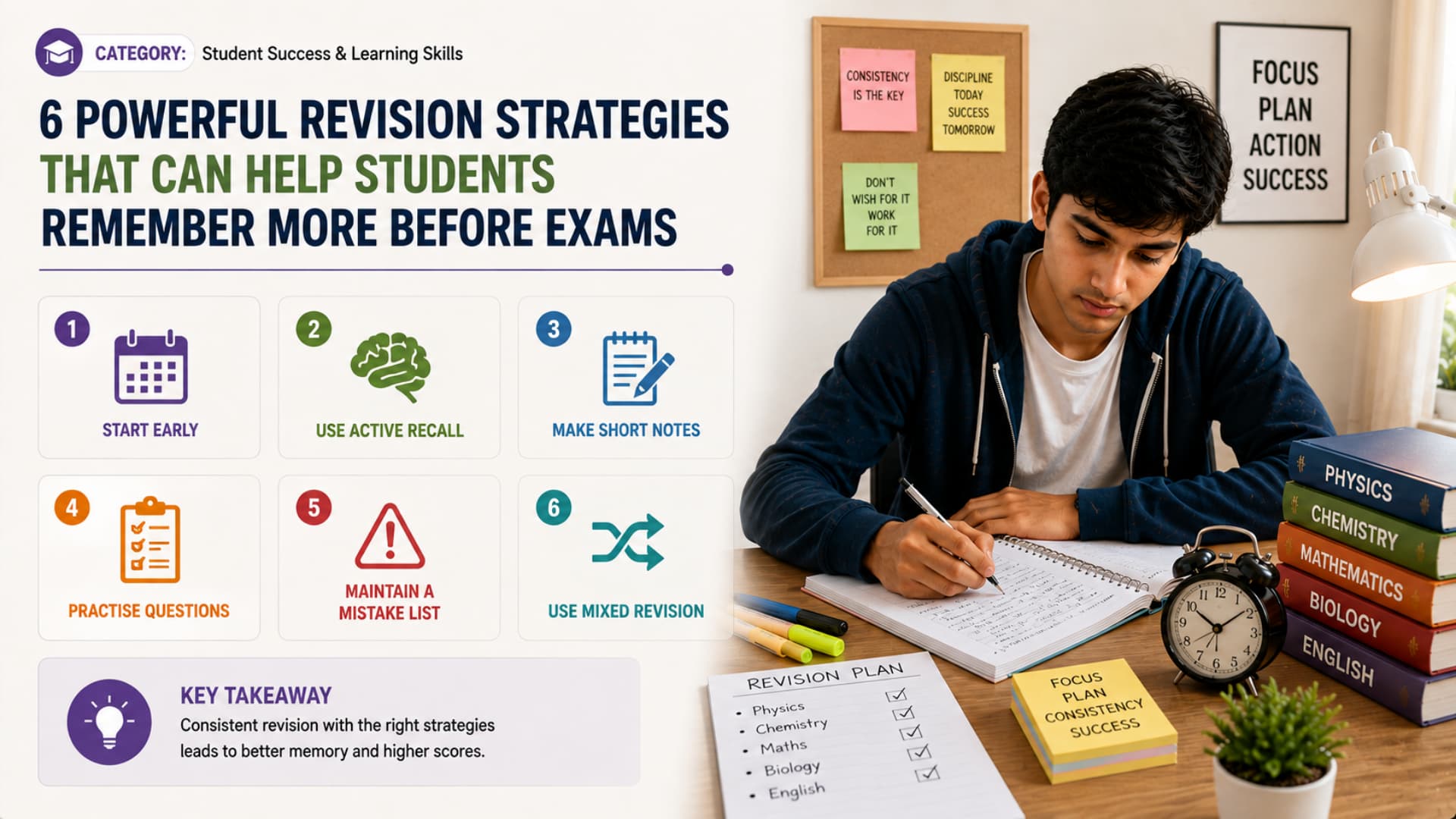
6 Powerful Revision Strategies That Can Help Students Remember More Before Exams
Revision Strategies • Exam Preparation • Memory • Study Skills • Student Success
Many students revise by reading the same chapter again and again.
It feels productive—but repeated reading alone does not always create strong recall.
Effective revision should help you retrieve, test, connect and strengthen what you have already learned.
The goal is not:
“How many times did I read this?”
The better question is:
“Can I remember and use this without looking?”
Here are 6 practical revision strategies that can help students remember more before exams.
________________________________________
1. Start Revision Before the Last Week
Last-minute revision creates pressure because too much information has to be recalled at once.
A better approach is to begin earlier and revise in smaller sessions.
Try This
For an important topic:
Day 1: Learn
Day 2: Quick recall
Day 4: Review
Day 7: Self-test
Why It Helps
Spacing revision gives the brain repeated opportunities to strengthen access to the information.
Revision Rule:
Start early. Revisit often.
________________________________________
2. Use Active Recall
After revising a topic, close the book.
Then ask yourself:
• What were the main points?
• What formulas do I remember?
• Can I explain the concept?
• Which parts did I forget?
Why It Works
Active recall forces the brain to retrieve information instead of only recognising it.
Use:
Read → Close → Recall → Check
This quickly shows whether your revision is actually working.
________________________________________
3. Create Short Revision Notes
Do not revise full chapters from beginning to end every time.
Convert important topics into:
• Formula sheets
• Flashcards
• Mind maps
• Key definitions
• Timelines
• One-page summaries
Why It Helps
Short notes reduce overload.
They help you focus on the information that genuinely needs to be remembered.
Student Tip
A good revision sheet should help you understand a topic at a glance.
________________________________________
4. Practise Questions Regularly
Revision is incomplete if you only read notes.
Use:
• Practice questions
• Sample papers
• Previous exam questions
• Self-quizzes
• Flashcards
Why It Matters
Questions force you to retrieve and apply information.
They also reveal:
• Weak areas
• Careless mistakes
• Misunderstood concepts
• Topics needing more practice
Revision Loop
Recall → Attempt → Check → Correct → Retry
That is far more useful than passive rereading.
________________________________________
5. Maintain a Mistake List
Students often repeat the same errors because they do not track them.
Create a simple mistake list.
Write down:
• Formulas you forget
• Concepts you confuse
• Calculation errors
• Important definitions
• Frequently missed questions
Why It Helps
Your revision becomes personalised.
Instead of spending equal time on everything, you can spend more time where improvement is actually needed.
Exam Tip
Before the exam, review your mistake list as carefully as your notes.
________________________________________
6. Use Mixed Revision
Do not always revise one subject for hours.
Mix different types of work.
For example:
20 minutes Maths
→ 20 minutes Science
→ Short Break
→ 20 minutes English Recall
You can also mix different question types within the same subject.
Why It Helps
Mixed revision keeps the brain more actively engaged and helps students practise choosing the correct approach for different problems.
Important
Do not switch every few minutes.
Use meaningful study blocks rather than constant multitasking.
Mix your revision—not your attention.
________________________________________
The REVISE Formula
R — Recall Without Looking
Test your memory.
E — Examine Weak Areas
Know what needs work.
V — Visit Topics Again
Use spaced revision.
I — Include Practice Questions
Apply what you learned.
S — Summarise Key Information
Create short revision tools.
E — Evaluate Mistakes
Correct and retry.
________________________________________
Key Takeaway
Good revision is not about repeatedly seeing information.
It is about repeatedly retrieving and using it.
Focus on:
Spacing • Active Recall • Short Notes • Practice • Mistake Correction • Mixed Revision
Instead of saying:
“I have revised the chapter.”
ask:
“Can I recall the key ideas and answer questions without looking?”
That is a stronger sign that revision is working.
Brain Gurukul Perspective
At Brain Gurukul, we believe revision should strengthen understanding and recall—not simply repeat information.
When students revise strategically, they enter exams with better clarity, confidence and preparedness.
Revise smarter. Recall stronger. Perform with confidence.
Read. Learn. Apply. Grow.
________________________________________
Blog Number: 50
Blog Name: 6 Powerful Revision Strategies That Can Help Students Remember More Before Exams
Word Count: ~770 words
Revision Strategies • Exam Preparation • Memory • Study Skills • Student Success