Student Success & Learning Skills
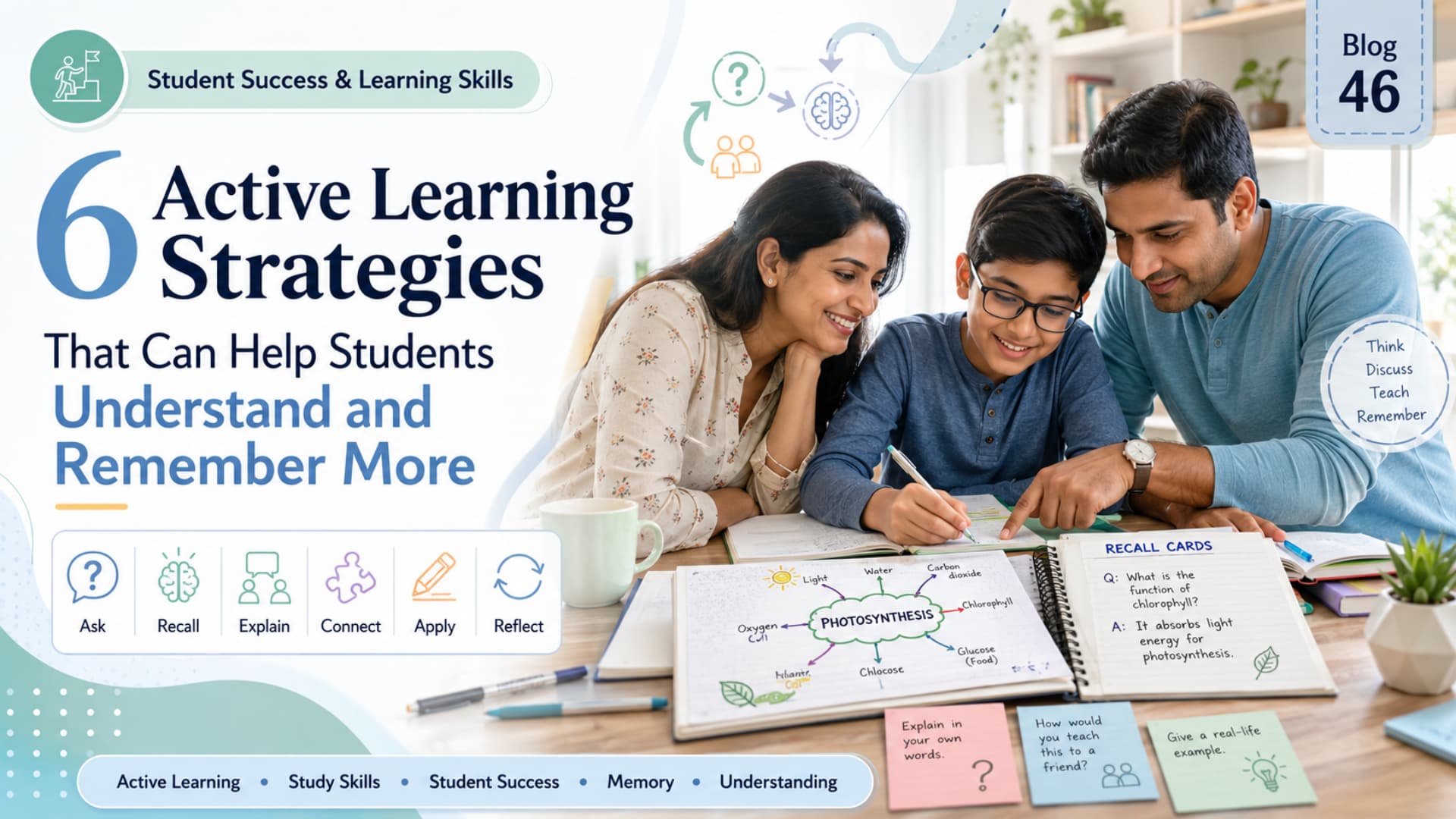
6 Active Learning Strategies That Can Help Students Understand and Remember More
Active Learning • Study Skills • Student Success • Memory • Understanding
Many students spend hours reading, highlighting and copying notes.
But there is one important question:
How much of that information can you actually explain, recall and use?
Passive studying may create familiarity, but active learning makes the brain work with the information.
That means retrieving, explaining, questioning, solving and applying what you learn.
Here are 6 active learning strategies that can help students understand more deeply and remember information better.
________________________________________
1. Close the Book and Recall
After studying a topic, stop looking at the material.
Ask yourself:
• What were the main ideas?
• What examples do I remember?
• What formula or definition can I recall?
• What did I forget?
Then reopen the material and check.
Why It Helps
This is called active recall.
Instead of repeatedly seeing the answer, your brain practises retrieving it.
Use This Formula
Learn → Close → Recall → Check
That simple habit can make revision far more active.
________________________________________
2. Explain the Topic in Your Own Words
If you really understand something, you should be able to explain it simply.
After learning a concept, pretend you are teaching it to someone younger.
Avoid copying textbook language.
Ask Yourself
“How would I explain this in simple words?”
Why It Matters
Explaining forces you to organise information.
If you become stuck, you have discovered a gap in understanding.
Study Tip
Do not memorise words you do not understand.
Understand first. Then remember.
________________________________________
3. Ask Better Questions
Strong learners do not only collect answers.
They ask questions.
While studying, ask:
• Why does this happen?
• How does this work?
• What would happen if something changed?
• How is this connected to what I already know?
• Where could I use this?
Why It Helps
Questions turn learning into exploration.
They help the brain connect ideas rather than treating every fact separately.
Learning Rule
The quality of your questions often improves the quality of your understanding.
________________________________________
4. Solve Problems Without Looking at Examples
Watching someone solve a problem can make it seem easy.
The real test comes when you attempt it yourself.
After studying an example:
Close it and solve a similar question independently.
Why It Matters
Independent practice reveals:
• What you understand
• What you forgot
• Where you make mistakes
• Which steps need more practice
Use the Practice Loop
Learn → Attempt → Check → Correct → Retry
This is especially useful for mathematics, science, grammar and other skill-based subjects.
________________________________________
5. Use Visual Maps and Diagrams
Sometimes information becomes easier to understand when you can see its structure.
Turn a chapter into:
• A mind map
• Flowchart
• Timeline
• Diagram
• Comparison table
Why It Helps
Visual organisation shows relationships between ideas.
Instead of remembering ten separate points, you begin seeing how they connect.
Study Tip
Create the visual yourself whenever possible.
The process of organising information is part of the learning.
________________________________________
6. Teach Someone Else
Teaching is one of the strongest ways to test your learning.
Choose a topic and explain it to:
• A Friend
• A Sibling
• A Parent
• A Study Partner
• An Imaginary Student
Ask them to interrupt with questions.
Why It Matters
Teaching requires you to:
Recall → Organise → Explain → Answer
That combination quickly reveals whether your understanding is strong or incomplete.
Student Challenge
After every important chapter, try giving a two-minute mini-lesson without using your notes.
________________________________________
The ACTIVE Formula
A — Ask Questions
Go beyond reading.
C — Close and Recall
Retrieve information yourself.
T — Teach the Concept
Explain it simply.
I — Investigate With Practice
Solve and apply.
V — Visualise Connections
Use maps and diagrams.
E — Evaluate Your Understanding
Find gaps and correct them.
________________________________________
Key Takeaway
Active learning is not about adding more study hours.
It is about changing what you do during those hours.
Instead of only:
Reading • Highlighting • Watching
add:
Recalling • Explaining • Questioning • Solving • Teaching
The more actively you work with information, the clearer your understanding becomes.
Instead of asking:
“Have I completed this chapter?”
ask:
“Can I explain and apply what I learned?”
That is a stronger measure of learning.
Brain Gurukul Perspective
At Brain Gurukul, we believe students learn better when they participate actively in the learning process.
Strong learning happens when knowledge is not only received—but also processed, recalled, connected and applied.
Don't just consume information. Work with it.
Read. Recall. Explain. Apply. Grow.
________________________________________
Blog Number: 46
Blog Name: 6 Active Learning Strategies That Can Help Students Understand and Remember More
Word Count: ~770 words
Active Learning • Study Skills • Student Success • Memory • Understanding