Parenting & Child Development
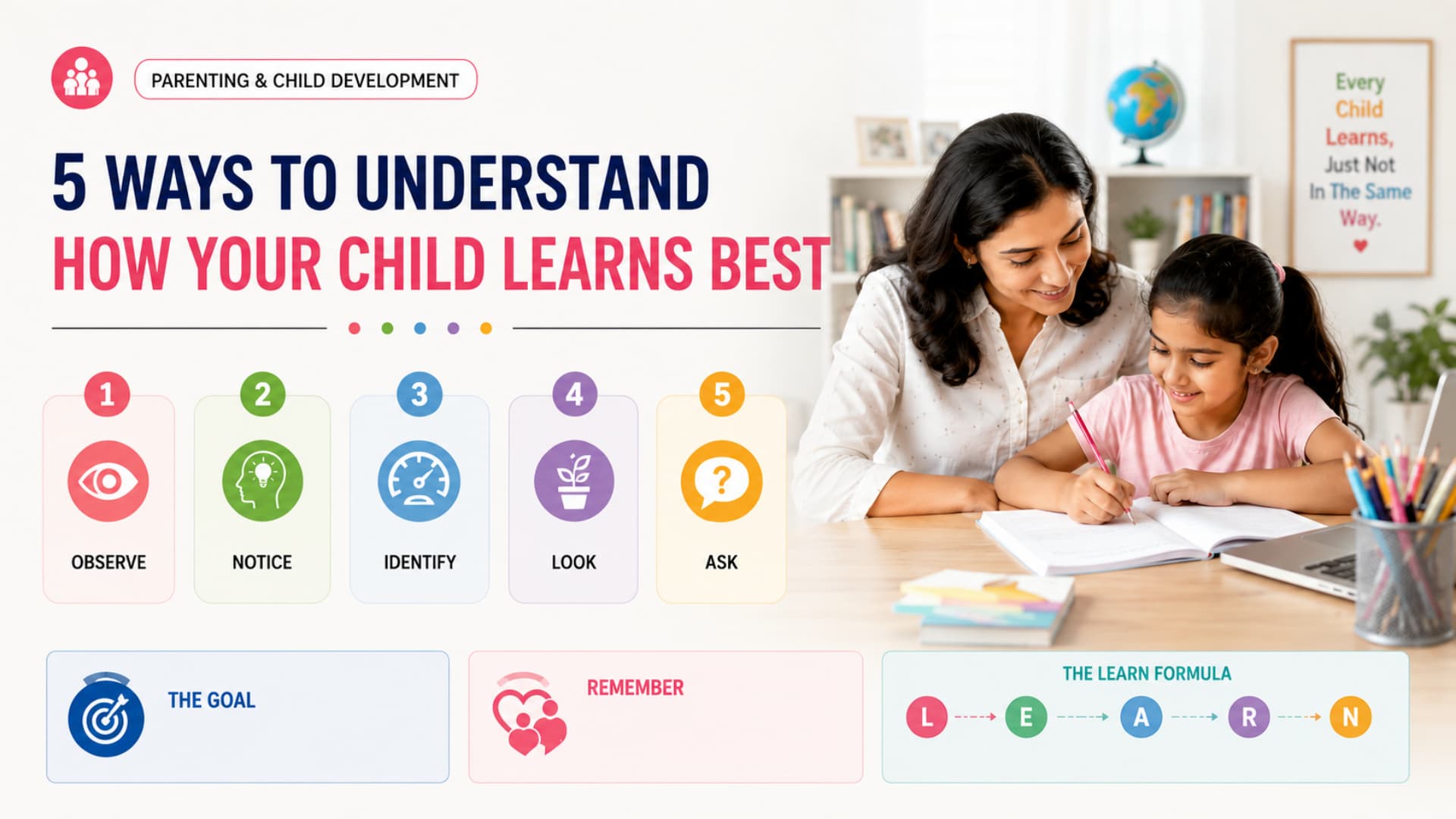
5 Ways to Understand How Your Child Learns Best
Child Learning • Parenting • Learning Preferences • Study Habits • Child Development
Have you ever wondered why your child understands one topic instantly but struggles with another?
Sometimes the issue is not ability.
It may be the way the information is being presented, practised or connected to what the child already knows.
Every child has a different combination of strengths, interests, attention patterns, confidence levels and prior knowledge. Understanding these differences can help parents support learning more effectively.
Here are 5 practical ways to understand how your child learns best.
________________________________________
1. Observe What Naturally Holds Their Attention
Attention gives parents useful clues.
Notice what your child can stay engaged with for longer:
• Stories
• Numbers
• Drawing
• Experiments
• Building activities
• Music
• Discussions
• Puzzles
Why It Matters
Children often show stronger engagement when a task connects with their interests or strengths.
This does not mean they should study only what they enjoy.
Instead, use their interests as a bridge to harder learning.
Parent Tip
Ask yourself:
“What makes my child naturally curious?”
That answer can reveal a lot about how to make learning more meaningful.
________________________________________
2. Notice How They Understand Difficult Ideas
When your child struggles, try explaining the same concept in different ways.
For example:
• Explain it verbally
• Draw a diagram
• Use a real-life example
• Demonstrate it
• Let the child practise it
• Ask them to explain it back
Why It Matters
The goal is not to permanently label a child as a “visual” or “auditory” learner.
Children often benefit from multiple ways of understanding the same idea.
What matters is discovering which explanation helps the concept become clearer.
Learning Rule
Change the method before assuming the child cannot learn the concept.
________________________________________
3. Identify the Right Learning Pace
Some children need more time to process instructions.
Others understand quickly but may make careless mistakes.
Both situations require different support.
Watch For
• Does your child need repetition?
• Do they rush?
• Do they need extra thinking time?
• Do long sessions reduce attention?
• Do short sessions work better?
Why It Matters
Learning pace is not the same as intelligence.
A child who learns slowly may still develop strong understanding when given enough time and practice.
Parent Tip
Focus on:
Understanding first → Speed later
Pressure to finish quickly can sometimes reduce learning quality.
________________________________________
4. Look at How Your Child Responds to Mistakes
Mistakes reveal more than academic gaps.
They also reveal how the child feels about learning.
Some children immediately try again.
Others become frustrated, embarrassed or afraid of being wrong.
Why It Matters
A child who fears mistakes may avoid challenging tasks even when capable of completing them.
Parents can help by responding calmly.
Instead of:
“Why did you get this wrong?”
try:
“Let's find where it went wrong.”
Build a Better Response
Teach the child:
Mistake → Understand → Correct → Retry
This creates a healthier learning pattern and gradually builds confidence.
________________________________________
5. Ask Your Child About Their Own Learning
Parents often observe children closely—but sometimes forget to ask them.
Even young learners can provide useful insights.
Try questions such as:
• Which subject feels easiest?
• Which one feels difficult?
• When do you concentrate best?
• What helps you remember?
• Do examples make it easier?
• What distracts you?
• How do you prefer to revise?
Why It Matters
These conversations develop self-awareness.
Over time, children begin understanding their own learning patterns.
That is an important step toward becoming an independent learner.
Parent Tip
Do not only ask:
“What marks did you get?”
Also ask:
“What did you discover about how you learn?”
________________________________________
The LEARN Formula
L — Look Closely
Observe interests, strengths and attention.
E — Experiment With Methods
Try explanation, examples, practice and visuals.
A — Adjust the Pace
Give enough time for understanding.R — Respond Positively to Mistakes
Turn errors into learning opportunities.
N — Notice the Child’s Voice
Ask what helps them learn.
________________________________________
Key Takeaway
Understanding how your child learns best does not require complicated testing.
Start with careful observation.
Notice:
What engages them.
What confuses them.
What helps them understand.
How they respond to mistakes.
What they say about their own learning.
The goal is not to put the child into a fixed category.
It is to create a more flexible learning approach that helps the child understand, practise and grow.
Brain Gurukul Perspective
At Brain Gurukul, we believe effective learning begins by understanding the learner before choosing the method.
When parents understand a child’s strengths, pace, interests and learning needs, guidance becomes more personalised and meaningful.
Understand how your child learns—and you can guide learning more intelligently.
Read. Learn. Apply. Grow.
________________________________________
Blog Number: 22
Blog Name: 5 Ways to Understand How Your Child Learns Best
Word Count: ~770 words
Child Learning • Parenting • Learning Preferences • Study Habits • Child Development