Brain Science & Brain Optimization
5 Powerful Stages of Memory That Decide What You Remember — And What You Forget
Memory Improvement • Learning Skills • Brain Development • Study Techniques • Student Success •
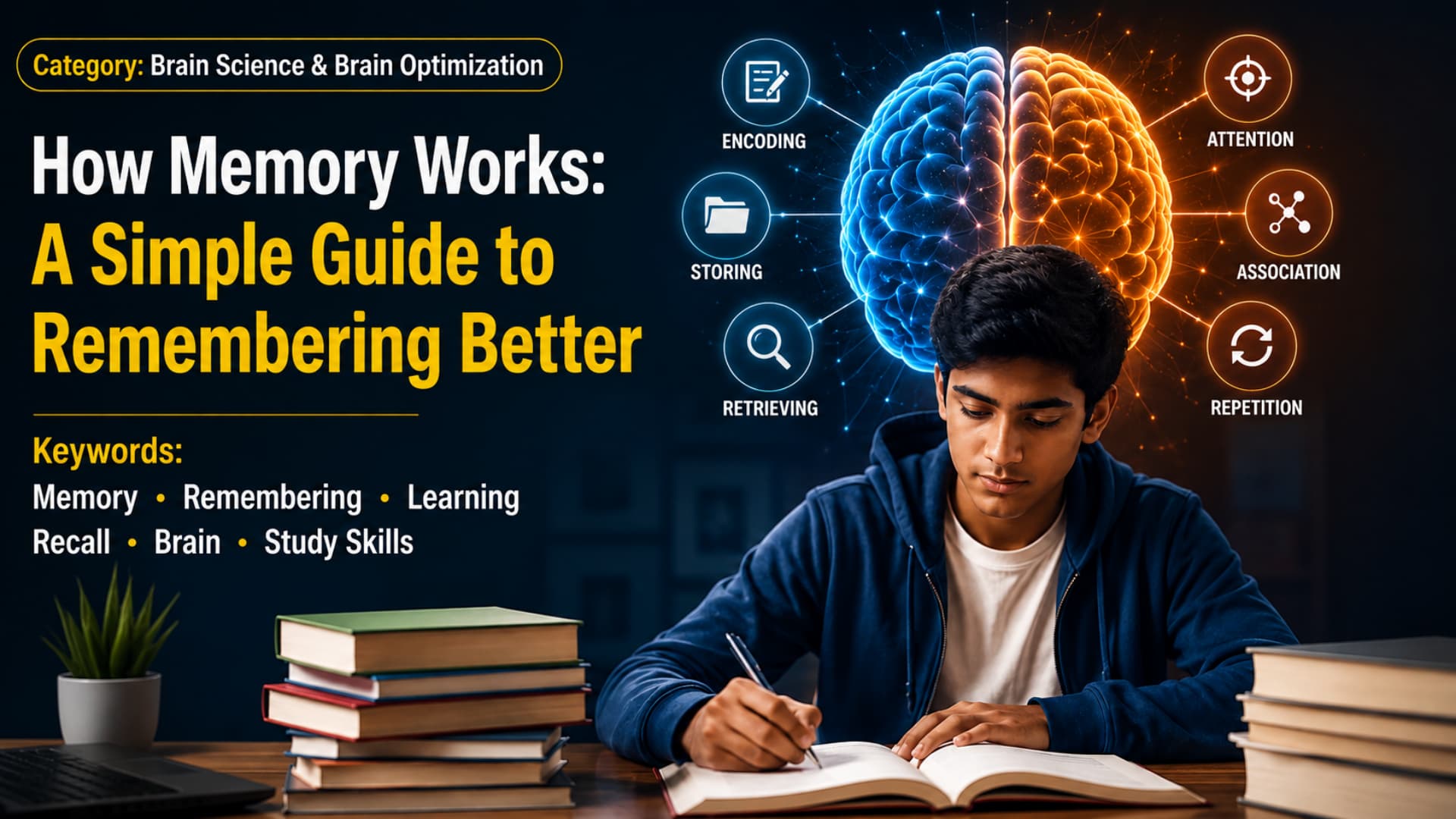
Have you ever wondered why you can remember the lyrics of your favourite song but forget what you studied yesterday?
The answer lies in how your brain processes information. Memory is not a single event—it's a carefully designed journey. Every piece of information passes through multiple stages before it becomes a lasting memory.
Understanding these stages can help students learn faster, remember longer, and perform better in academics and everyday life.
Let's explore the five powerful stages of memory that determine whether information stays with you—or disappears.
________________________________________
1. Attention – The Gateway to Memory
Nothing can be remembered unless the brain notices it first.
Attention is the starting point of every learning experience. When your mind is distracted by phones, conversations, stress, or multitasking, very little information enters the memory system.
Remember:
No Attention = No Memory
Creating a distraction-free learning environment significantly improves learning efficiency.
________________________________________
2. Encoding – Giving Information Meaning
Once information gains your attention, the brain converts it into a format it can understand and store. This process is called encoding.
The brain remembers meaningful information much better than random facts. Connecting new ideas with existing knowledge, using examples, colours, visuals, stories, or memory techniques makes encoding stronger.
Tip:
Learn to understand first—not just memorize.
________________________________________
3. Storage – Building Long-Term Memory
After encoding, the brain stores information for future use.
Some information stays only for a few seconds, while important and frequently used knowledge moves into long-term memory. Regular revision, repeated practice, and meaningful learning help strengthen this storage process.
The stronger the storage, the easier it becomes to remember later.
________________________________________
4. Consolidation – Making Memory Stronger
Memory does not become permanent immediately.
Your brain continues strengthening newly learned information even after you stop studying. This process is called consolidation, and it happens especially during quality sleep and regular spaced revision.
This is why studying for a short time over several days is far more effective than last-minute cramming.
Golden Rule:
Sleep is an essential part of learning.
________________________________________
5. Retrieval – Bringing Information Back
The final stage is retrieval—the ability to recall stored information whenever needed.
Every time you answer a question, solve a problem, explain a concept, or take an exam, your brain retrieves stored memories.
The more frequently you practise recalling information through quizzes, discussions, writing, or teaching others, the stronger retrieval becomes.
Remember:
The brain remembers best what it retrieves often.
________________________________________
Why Do We Forget?
Forgetting usually happens because one or more memory stages become weak.
Common reasons include:
• Poor attention while learning
• Lack of understanding
• Insufficient revision
• Sleep deprivation
• Limited recall practice
Fortunately, these habits can be improved with the right learning strategies.
________________________________________
How to Strengthen Every Stage of Memory
Students can improve memory by:
• Studying with complete focus
• Understanding concepts instead of rote learning
• Using visual learning and memory techniques
• Revising at regular intervals
• Getting adequate sleep
• Practising active recall and self-testing
Small daily improvements create powerful long-term results.
________________________________________
Final Thoughts
Excellent memory is not a natural gift possessed by only a few people. It is a skill developed through healthy brain habits and effective learning techniques.
When students strengthen Attention, Encoding, Storage, Consolidation, and Retrieval, learning becomes easier, confidence grows, and academic performance improves naturally.
Understanding how memory works is the first step toward unlocking your true learning potential.
________________________________________
Brain Gurukul Insight
At Brain Gurukul®, our Brain Optimization programmes are designed to strengthen the cognitive skills that support every stage of memory—including attention, processing, retention, recall, and learning efficiency—helping students become smarter, more confident, and future-ready learners.
________________________________________
Word Count: ≈ 625 words
Memory Improvement • Learning Skills • Brain Development • Study Techniques • Student Success •