Brain Gurukul Programme Knowledge Hub
10 Powerful Mnemonic Techniques That Can Make Remembering Easier
Mnemonics • Memory Techniques • Recall • Study Skills • Brain Gurukul

Remembering becomes easier when information is organised in a way the brain can retrieve more efficiently.
Mnemonics are practical memory techniques that help learners connect, structure, visualise and recall information.
They do not replace understanding.
They make important information easier to remember after it has been understood.
Here are 10 powerful mnemonic techniques that can make remembering easier.
________________________________________
1. Acronyms
An acronym uses the first letters of several words to create a shorter, memorable word.
For example:
HOMES can help remember the Great Lakes:
Huron • Ontario • Michigan • Erie • Superior
Why It Helps
A long list becomes one compact memory cue.
Memory Rule
Compress the information. Remember the cue.
________________________________________
2. Acrostics
An acrostic creates a sentence where each word begins with the letter you need to remember.
For example:
My Very Educated Mother Just Served Us Noodles
can help remember the order of planets.
Why It Helps
A meaningful or funny sentence is often easier to recall than isolated terms.
________________________________________
3. Chunking
Chunking means breaking long information into smaller groups.
Instead of remembering:
1 9 4 7 2 0 2 6
you might organise it as:
1947 • 2026
Why It Helps
Smaller groups reduce mental overload.
Learning Principle
Break it down before trying to remember it.
________________________________________
4. Visualisation
Turn information into a mental picture.
If you need to remember a concept, imagine it as:
• A scene
• An object
• A character
• An action
Why It Helps
Vivid images can create stronger retrieval cues.
Memory Tip
The more unusual the image, the easier it may be to remember.
________________________________________
5. Association
Connect new information with something familiar.
For example:
To remember a new name, connect it with:
• A known person
• A familiar object
• A sound
• A visual image
Why It Helps
New information becomes easier to retrieve when attached to an existing memory.
Memory Question
“What can I connect this with?”
________________________________________
6. Rhymes and Rhythm
Information can become easier to remember when converted into:
• A rhyme
• A beat
• A short chant
• A rhythmic pattern
Why It Helps
Sound patterns create additional memory cues.
This can be especially useful for formulas, sequences or definitions.
Memory Principle
If you can say it rhythmically, you may remember it more easily.
________________________________________
7. The Story Method
Take several unrelated items and connect them through one imaginative story.
For example:
If you need to remember:
Book • Key • Apple • Train
imagine:
A giant book opens, a golden key falls out, unlocks an apple, and a train appears inside.
Why It Helps
The story creates sequence and meaning.
Memory Rule
Turn a list into a journey.
________________________________________
8. The Method of Loci
This technique is also called the Memory Palace.
Choose a familiar place, such as your home.
Mentally place information at different locations:
• Door
• Sofa
• Table
• Kitchen
• Bedroom
Then mentally walk through the location to recall the information.
Why It Helps
It combines memory with spatial familiarity.
Simple Process
Choose Place → Place Information → Walk Mentally → Recall
________________________________________
9. Keyword Method
This technique is useful for vocabulary or unfamiliar terms.
Choose a familiar word that sounds similar to the new word.
Then connect both through a mental image.
Why It Helps
The familiar keyword acts as a bridge to the unfamiliar information.
Learning Tip
Make the image vivid and easy to picture.
________________________________________
10. Peg System
The peg system attaches information to a fixed set of memory cues.
For example:
1 — Bun
2 — Shoe
3 — Tree
4 — Door
Then connect each item you want to remember with the corresponding peg.
Why It Helps
The fixed structure gives information a predictable place.
Memory Principle
Attach new information to something already memorised.
________________________________________
The MEMORY Formula
M — Make Connections
Use associations.
E — Engage Imagination
Create vivid images.
M — Make Information Smaller
Use chunking.
O — Organise in Sequence
Use stories, pegs or loci.
R — Repeat and Recall
Practise retrieval.
Y — Your Meaning Matters
Understand before memorising.
________________________________________
Key Takeaway
Mnemonics work best when they make information:
Meaningful • Visual • Structured • Connected • Easier to Retrieve
Use:
Acronyms • Acrostics • Chunking • Visualisation • Association • Rhythm • Stories • Memory Palace • Keywords • Peg Systems
Good memory is not only about repetition. It is also about creating better retrieval cues.
Brain Gurukul Perspective
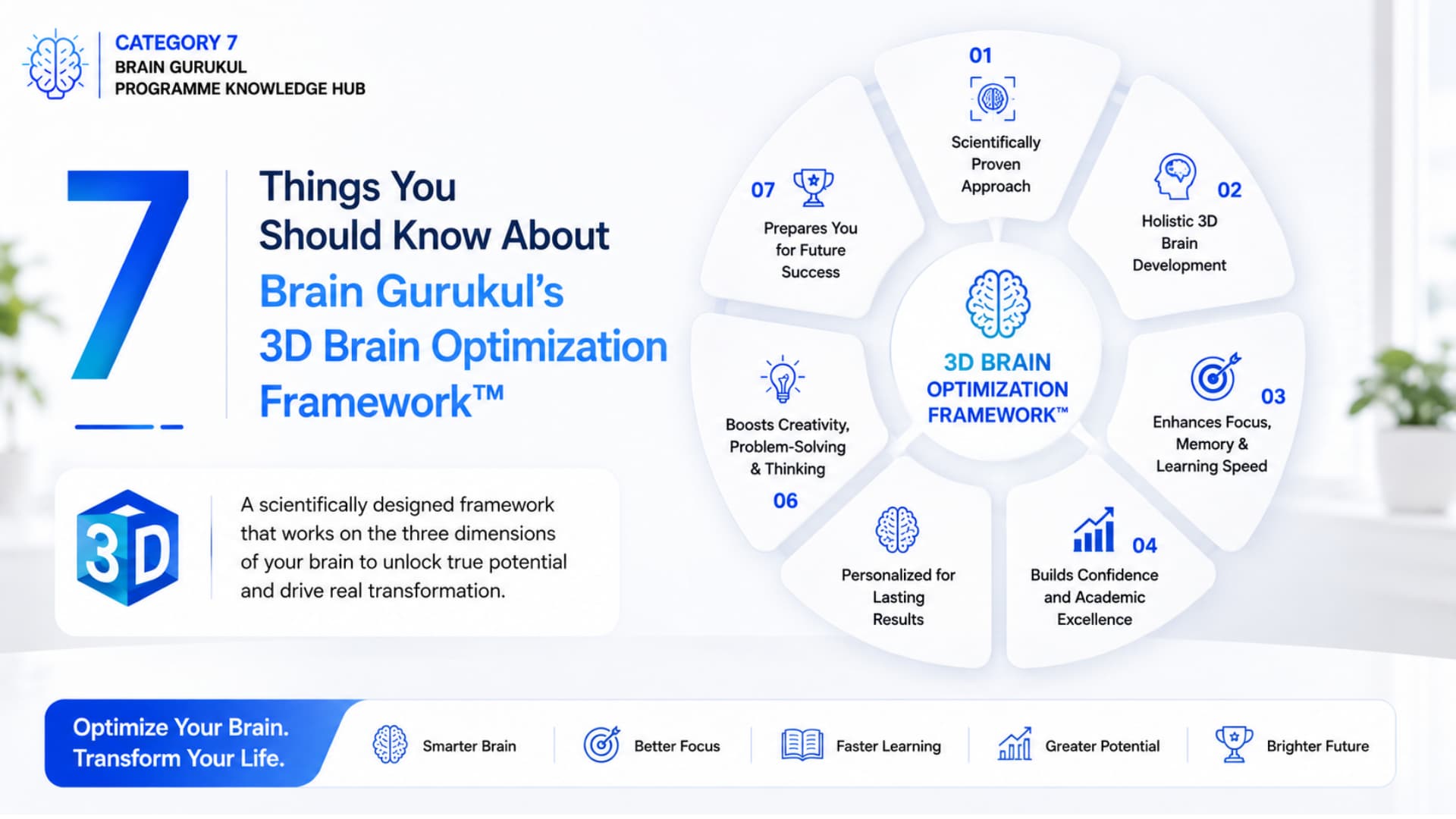
At Brain Gurukul, mnemonics are positioned as part of the DESIGN stage of the 3D Brain Optimization Framework™.
The objective is to help learners organise information more intelligently and strengthen memory and recall through practical learning techniques.
Mnemonics are most effective when combined with understanding, attention, revision and active recall.
Understand first. Connect intelligently. Remember confidently.
Read. Learn. Apply. Grow.
________________________________________
Blog Number: 105
Blog Name: 10 Powerful Mnemonic Techniques That Can Make Remembering Easier
Word Count: ~760 words
Mnemonics • Memory Techniques • Recall • Study Skills • Brain Gurukul