Brain Science & Brain Optimization
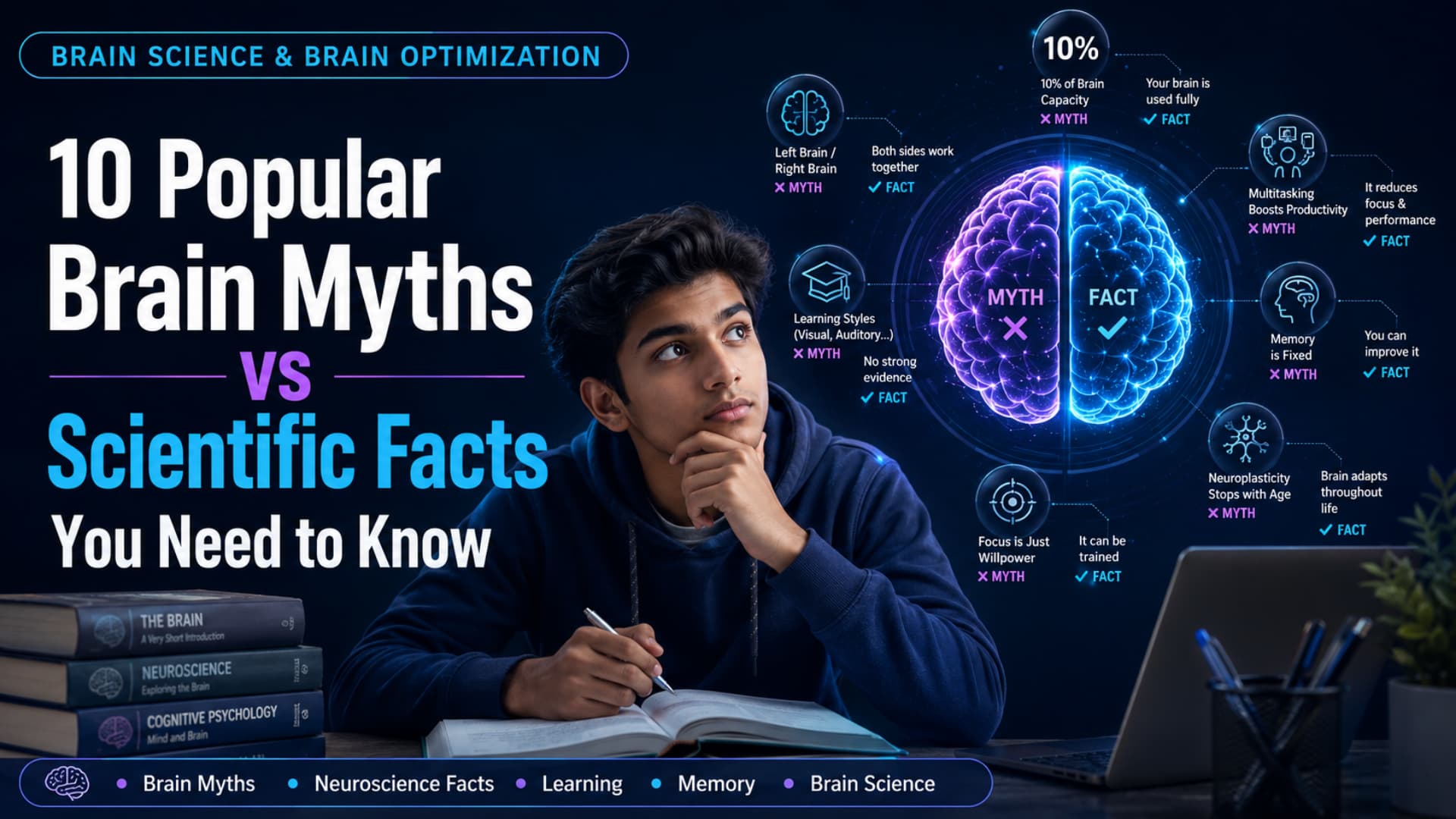
10 Popular Brain Myths vs Scientific Facts You Need to Know
Brain Myths • Neuroscience Facts • Learning • Memory • Brain Science
The human brain is fascinating—but it is also surrounded by myths.
Some sound scientific because they have been repeated for years. Others started from genuine research but became oversimplified along the way.
Neuromyths remain surprisingly common, even among educators and people exposed to neuroscience.
Here are 10 popular brain myths—and what science actually tells us.
________________________________________
1. Myth: We Use Only 10% of Our Brain
Fact
We use all parts of the brain, although different regions become more or less active depending on what we are doing.
Brain imaging has clearly disproved the idea that 90% of the brain sits unused.
Brain Fact:
The opportunity is not to “unlock” unused brain tissue—but to use existing abilities more effectively.
________________________________________
2. Myth: People Are Either Left-Brained or Right-Brained
Fact
Some functions show hemispheric specialisation, but everyday thinking depends on communication between both sides of the brain.
So being creative does not make you purely “right-brained,” and being analytical does not make you purely “left-brained.”
Better Idea
Develop abilities instead of accepting labels.
________________________________________
3. Myth: Everyone Has One Fixed Learning Style
You may have heard:
“I am a visual learner.”
or:
“He only learns through listening.”
Fact
People can certainly have preferences, but evidence does not support the idea that teaching someone only in their preferred visual, auditory or kinaesthetic style reliably improves learning. The learning-styles belief is one of the most persistent educational neuromyths.
Good learning often combines several methods.
________________________________________
4. Myth: Intelligence Is Completely Fixed
Fact
Genetics matters, but experience, education, practice, environment and opportunity also influence how abilities develop.
The brain remains capable of adaptation through neuroplasticity.
Instead of saying:
“I am simply bad at this,”
a better question is:
“What skill, strategy or practice am I missing?”
________________________________________
5. Myth: Multitasking Makes the Brain More Productive
Fact
When two demanding tasks require attention, the brain often switches rapidly between them rather than performing both equally well.
That switching can increase mistakes and mental effort.
Better Strategy
Single-task → Finish → Switch
For studying and complex work, focused attention usually produces better-quality performance.
________________________________________
6. Myth: Memory Works Like a Video Recorder
Fact
Memory is not a perfect recording of everything we experience.
Memories are encoded, stored and later reconstructed during recall.
That means memories can sometimes become incomplete, altered or influenced by later information.
Learning Lesson
Do not depend only on recognition.
Use:
Active recall • Review • Practice • Application
________________________________________
7. Myth: More Study Hours Always Mean Better Learning
Fact
Study quality matters as much as study duration.
Three distracted hours may accomplish less than one focused session using retrieval practice, spaced revision and meaningful application.
Better Question
Instead of:
“How long did I study?”
Ask:
“How effectively did I learn?”
________________________________________
8. Myth: Children Must Learn Everything Important Very Early
Fact
Early childhood is extremely important, but the idea that learning becomes impossible after a narrow “critical period” is an oversimplification for many abilities.
The brain continues changing through experience across life, although some abilities may be easier to develop during particular developmental periods. Neuromyth research identifies exaggerated claims about rigid critical periods as a recurring misconception.
________________________________________
9. Myth: Sugar Automatically Makes Every Child Hyperactive
Fact
The common claim that sugary foods directly make children hyperactive is not strongly supported as a universal effect.
Studies of neuromyths repeatedly identify this belief as a common misconception.
That does not make nutrition unimportant.
Healthy eating still matters for overall physical and brain health.
________________________________________
10. Myth: Brain Training Requires Complicated Technology
Fact
Supporting better learning does not always require expensive devices.
Powerful everyday strategies include:
• Focused attention
• Active recall
• Spaced revision
• Physical activity
• Adequate sleep
• Learning new skills
• Regular practice
Technology can support learning—but it is not a substitute for sound learning habits.
________________________________________
The FACTS Formula
F — Find Reliable Evidence
Don't believe every brain claim online.
A — Avoid Labels
Your abilities are more complex than simple categories.
C — Challenge Popular Claims
Repeated information is not automatically correct.
T — Train Meaningfully
Practise strategies supported by learning science.
S — Stay Curious
Brain science continues to evolve.
________________________________________
Key Takeaway
The brain is already extraordinary.
We do not need myths to make it more impressive.
Understanding the difference between popular claims and scientific evidence helps parents, students and educators make better learning decisions.
Brain Gurukul Perspective
At Brain Gurukul, we believe Brain Optimization should be guided by curiosity, practical learning and responsible understanding of the brain—not exaggerated claims.
Know the facts. Understand your brain. Learn smarter.
Read. Learn. Apply. Grow.
(WC = 770)
Brain Myths • Neuroscience Facts • Learning • Memory • Brain Science