
Parenting & Child Development
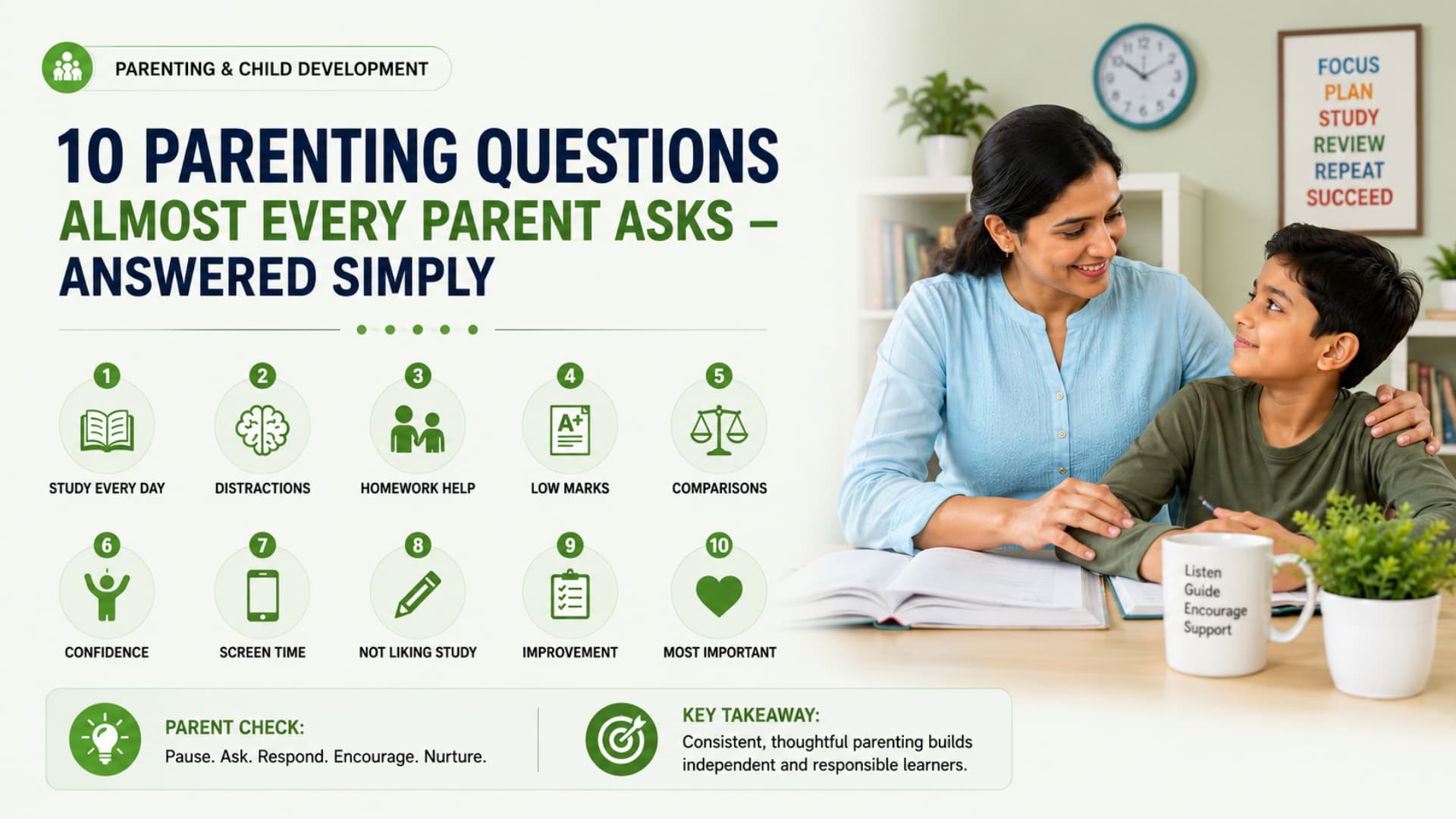
10 Parenting Questions Almost Every Parent Asks — Answered Simply
Parenting Questions • Child Development • Positive Parenting • Child Learning • Parenting Tips
Parenting rarely comes with simple answers.
One day you may be worried about screen time. The next day it may be focus, confidence, homework, behaviour or comparison with other children.
The good news is that many parenting concerns become easier when we focus on understanding the child, building healthy routines and responding consistently.
Here are 10 common parenting questions—answered simply and practically.
________________________________________
1. How Much Should My Child Study Every Day?
There is no perfect number of hours for every child.
Study time depends on:
• Age
• School workload
• Attention span
• Subject difficulty
• Energy level
Better Approach
Focus on quality of study, not only duration.
Short, focused sessions with clear goals are often more useful than long distracted hours.
Parent Tip:
Measure what was learned—not only how long the child sat.
________________________________________
2. Why Does My Child Get Distracted So Easily?
Distraction can come from many sources:
• Phones
• Television
• Noise
• Stress
• Lack of sleep
• Difficult tasks
• Poor routines
What Helps
Create a simple study space, remove unnecessary devices and use shorter focus sessions.
Instead of repeatedly saying:
“Concentrate!”
help create conditions that make concentration easier.
________________________________________
3. Should I Help With Homework?
Yes—but help should not become doing the homework for the child.
Try:
Explain → Ask → Guide → Let the child complete
Why It Matters
Too much help can create dependence.
The goal is to gradually move from:
Parent-supported learning
to:
Independent learning
________________________________________
4. What Should I Do When My Child Gets Low Marks?
Start with understanding, not anger.
Ask:
• Which questions were difficult?
• Was the concept unclear?
• Was revision insufficient?
• Were mistakes careless?
• Was time management a problem?
Better Response
Use marks as feedback, not identity.
One poor result does not define a child's ability.
Focus on what needs to improve next.
________________________________________
5. Should I Compare My Child With Other Children?
Comparison may appear motivating, but it can create unnecessary pressure.
Every child has different:
• Strengths
• Interests
• Learning pace
• Confidence
• Developmental needs
Better Comparison
Compare your child with their own previous performance.
Ask:
“What has improved since last time?”
Progress is a healthier benchmark.
________________________________________
6. How Can I Improve My Child’s Confidence?
Confidence grows through capability.
Give children opportunities to:
• Make decisions
• Solve small problems
• Take responsibility
• Try difficult tasks
• Learn from mistakes
Praise effort and improvement—not only success.
Remember
Confidence grows when children experience themselves becoming capable.
________________________________________
7. How Much Screen Time Is Too Much?
The answer depends on age, purpose and routine.
Educational use is different from endless entertainment.
Instead of focusing only on total minutes, also ask:
• Is sleep affected?
• Is physical activity reduced?
• Is study constantly interrupted?
• Is family interaction declining?
• Can the child stop when asked?
Better Goal
Build balanced digital habits, not constant battles.
________________________________________
8. What If My Child Does Not Like Studying?
First identify why.
The reason may be:
• Weak foundations
• Boredom
• Difficulty
• Fear of failure
• Distraction
• Lack of confidence
What Helps
Break work into smaller goals, connect topics with real-life examples and celebrate visible progress.
Sometimes the child does not dislike learning.
They dislike struggling without knowing how to improve.
________________________________________
9. How Can I Make My Child More Responsible?
Responsibility develops through practice.
Start with simple tasks:
• Pack the school bag
• Organise books
• Follow a routine
• Complete homework
• Manage personal belongings
Avoid reminding repeatedly when the child can reasonably manage the task.
Parent Rule
Give responsibility gradually—and allow ownership to grow.
________________________________________
10. What Is the Most Important Thing I Can Do as a Parent?
There is no single perfect parenting technique.
But one powerful principle is:
Stay connected while helping your child become capable.
Listen.
Guide.
Set boundaries.
Encourage effort.
Allow mistakes.
Support independence.
Your child does not need a perfect parent.
They need consistent guidance and a safe relationship in which growth is possible.
________________________________________
The PARENT Check
When unsure what to do, ask:
P — Pause
Am I reacting emotionally?
A — Ask
What is really happening?
R — Respond
What does my child need to learn?
E — Encourage
How can I build confidence?
N — Nurture Independence
Can the child handle part of this?
T — Teach
What lesson should remain after this situation?
________________________________________
Key Takeaway
Good parenting is not about having the perfect answer every time.
It is about making thoughtful decisions repeatedly.
Focus on:
Connection • Routine • Responsibility • Confidence • Independence • Healthy Boundaries
Small parenting habits practised consistently can create meaningful long-term impact.
Brain Gurukul Perspective
At Brain Gurukul, we believe parents are a child’s first and most influential learning partners.
When parents understand the child better, they can guide learning, habits and development with greater clarity.
Understand more. Compare less. Guide better.
Read. Learn. Apply. Grow.
________________________________________
Blog Number: 30
Blog Name: 10 Parenting Questions Almost Every Parent Asks — Answered Simply
Word Count: ~780 words
Parenting Questions • Child Development • Positive Parenting • Child Learning • Parenting Tips