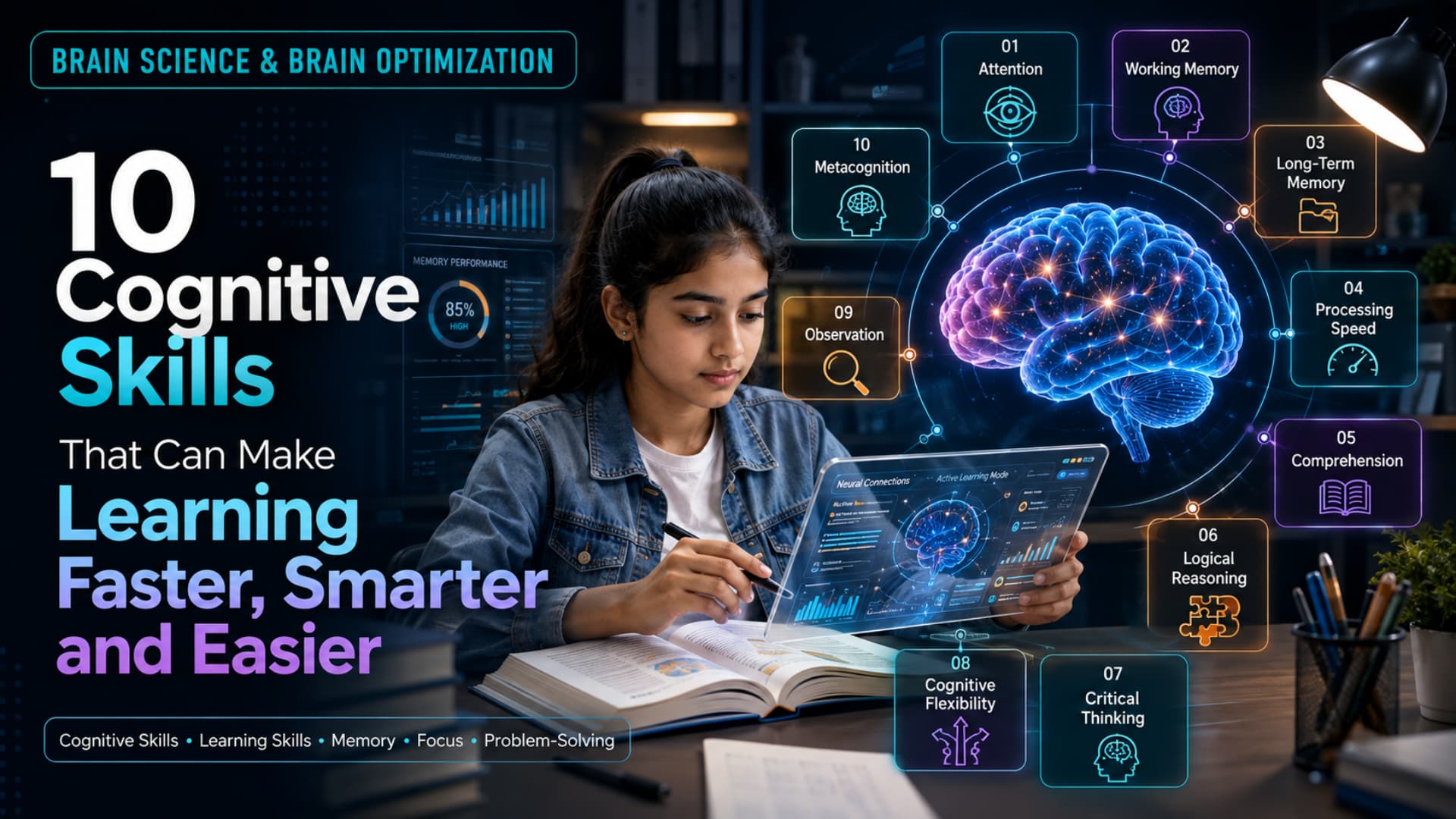
Brain Science & Brain Optimization
10 Cognitive Skills That Can Make Learning Faster, Smarter and Easier
Cognitive Skills • Learning Skills • Memory • Focus • Problem-Solving
Why do some learners understand faster, remember better and solve problems more confidently?
Often, the difference is not only what they know.
It is also the strength of the mental skills they use while learning.
These are called cognitive skills—the brain-based abilities that help us pay attention, process information, remember, understand, reason and make decisions.
Here are 10 important cognitive skills that can make learning faster, smarter and easier.
________________________________________
1. Attention
Attention helps the brain focus on what matters.
Without it, even good teaching can be lost.
Strengthen It By
• Removing distractions
• Working in focused blocks
• Setting one clear goal
• Avoiding unnecessary multitasking
Attention is the doorway to learning.
________________________________________
2. Working Memory
Working memory helps you hold information in mind while using it.
It supports tasks such as:
• Mental maths
• Following instructions
• Reading comprehension
• Problem-solving
Strengthen It By
Breaking information into smaller parts and recalling key points regularly.
________________________________________
3. Long-Term Memory
Long-term memory helps store information for later use.
A learner may understand a concept today—but real learning becomes more powerful when it can be recalled later.
Improve It With
Active recall • Spaced revision • Association • Meaningful practice
Learning is stronger when knowledge can be retrieved when needed.
________________________________________
4. Processing Speed
Processing speed refers to how efficiently the brain can understand and respond to information.
It can influence:
• Reading
• Writing
• Classroom responses
• Calculations
• Everyday decision-making
Helpful Approach
Practise familiar skills regularly, but do not confuse speed with rushing.
Accuracy and understanding remain important.
________________________________________
5. Comprehension
Reading words is not the same as understanding them.
Comprehension allows the learner to identify meaning, connect ideas and explain information.
Build It By Asking
• What does this mean?
• Why is it important?
• Can I explain it simply?
• Can I give an example?
Understanding should come before memorisation.
________________________________________
6. Logical Reasoning
Logical reasoning helps you recognise relationships, compare information and reach sensible conclusions.
It is especially useful in:
• Mathematics
• Science
• Coding
• Decision-making
• Problem-solving
Strengthen It Through
Puzzles, reasoning questions, pattern recognition and real-life problems.
________________________________________
7. Critical Thinking
Critical thinking helps learners go beyond accepting information immediately.
It encourages questions such as:
Is this accurate?
What evidence supports it?
Is there another explanation?
Why It Matters
In a world full of information, knowing how to evaluate information is becoming as important as knowing information itself.
________________________________________
8. Cognitive Flexibility
Sometimes the first solution does not work.
Cognitive flexibility helps the brain change direction and try another approach.
It Supports
• Adaptability
• Creativity
• Problem-solving
• Learning from feedback
• Handling change
Learning Tip
Instead of asking:
“Why isn't this working?”
also ask:
“What else could I try?”
________________________________________
9. Observation
Strong observation helps learners notice details that others may miss.
Observation supports:
• Science
• Reading
• Art
• Communication
• Problem-solving
• Everyday awareness
Practise It
Look at an object or situation carefully, then describe what you noticed without looking again.
Small exercises can make attention to detail more conscious.
________________________________________
10. Metacognition
Metacognition simply means thinking about your own thinking and learning.
It helps learners ask:
• What do I understand?
• What am I struggling with?
• Which strategy worked?
• Where did I make a mistake?
• What should I change next time?
Why It Matters
Metacognition helps learners become more independent.
Instead of only receiving instructions, they begin managing their own learning.
________________________________________
The SMART Learning Formula
S — Strengthen Attention
Protect focus.
M — Manage Memory
Recall and revise intelligently.
A — Analyse Information
Think critically and logically.
R — Respond Flexibly
Adapt strategies when needed.
T — Track Your Thinking
Reflect and improve.
________________________________________
Key Takeaway
Cognitive skills are the hidden tools behind effective learning.
They help learners:
Focus • Understand • Remember • Think • Adapt • Perform
The goal is not simply to collect more information.
It is to strengthen the abilities that help the brain use information better.
Brain Gurukul Perspective
At Brain Gurukul, we believe Brain Optimization should develop the learner—not only prepare the learner for the next test.
Strengthening cognitive skills can support better learning today while building abilities that remain useful throughout life.
Build stronger thinking skills—and every subject becomes easier to approach.
Read. Learn. Apply. Grow.
________________________________________
Blog Number: 18
Blog Name: 10 Cognitive Skills That Can Make Learning Faster, Smarter and Easier
Word Count: ~775 words
Cognitive Skills • Learning Skills • Memory • Focus • Problem-Solving